
Introduction
Air freezing is one of the most widely used freezing methods in industrial food processing. It offers broad product compatibility, relatively straightforward operating principles, and easy integration into continuous production lines. In industrial applications, both conventional air blast freezers and fluidized bed freezers use forced circulation of cold air to remove heat from food products. However, they differ significantly in airflow distribution, product movement, and freezing process control.
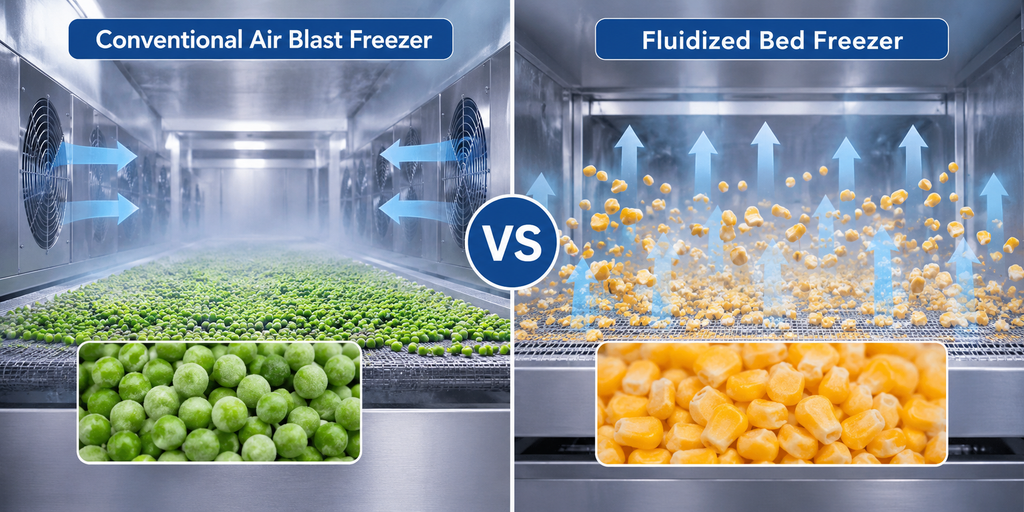
Conventional air blast freezers typically use fans to circulate cold air throughout an insulated freezing chamber, exposing products to cold air while they are placed on trays, mesh belts, or other conveying systems. Depending on product arrangement and loading density, individual pieces may remain separated or become attached to one another during freezing.
Fluidized bed freezers, by contrast, use upward-moving high-velocity cold air to partially or fully suspend small food particles within the airflow. This reduces prolonged contact between individual pieces and helps maintain product separation throughout the freezing process.
Understanding the differences between these technologies is important for food processors handling vegetables, fruits, seafood, and other products requiring Individual Quick Freezing (IQF).
1. Individual Freezing vs. Bulk Freezing: How Do the Two Systems Handle Products?
One of the most significant differences between these freezing technologies is how products are arranged and whether individual pieces can remain separated during freezing.
1.1 Conventional Air Blast Freezer: Product Arrangement and Airflow Distribution
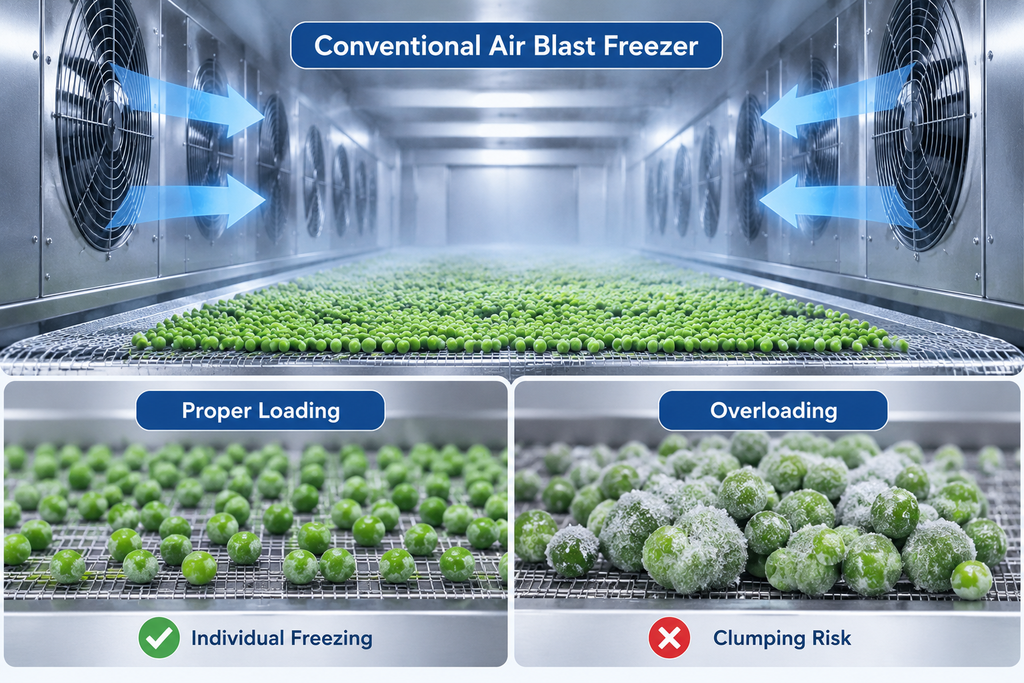
A conventional air blast freezer uses fans to circulate low-temperature air throughout the freezing chamber. Products are placed on trays, mesh belts, or other conveying systems.
Freezing performance depends on air temperature, velocity, product loading density, and the duration of exposure to cold air.
When products are arranged in a single layer with adequate spacing, individual freezing can also be achieved. However, when products are loaded too densely or stacked in multiple layers, several problems may occur:
- Products may come into contact and freeze together, forming clusters or blocks.
- Reduced spacing between products can restrict airflow.
- Freezing rates may vary depending on product position within the chamber.
- Additional mechanical separation or manual handling may be required after freezing.
It is important to note that conventional air blast freezers are not inherently incapable of producing IQF products. With proper control of loading patterns, product spacing, and airflow distribution, they can also achieve satisfactory individual freezing results.
However, maintaining individual separation throughout the freezing process can be more challenging when processing small particles that tend to stick together.
1.2 Fluidized Bed Freezer: Maintaining Individual Separation Through Airflow

Fluidized bed freezers are specifically designed for small, relatively uniform food particles.
Products are evenly distributed across a perforated conveyor belt. Low-temperature air is forced upward through the belt and the product layer. When airflow velocity reaches a sufficient level, the upward aerodynamic force partially or fully counteracts the effective weight of the particles, causing them to become suspended or continuously agitated.
This condition is known as fluidization.
During freezing, continuous particle movement reduces prolonged contact between individual pieces, lowering the likelihood of products freezing together.
Typical applications include:
- Green peas and sweet corn kernels
- Diced carrots and potatoes
- Blueberries and other small berries
- Individual shrimp and small seafood products
- Diced or sliced vegetables
The primary advantage of fluidized bed technology is not simply improved freezing performance. More importantly, it helps maintain individual product separation under appropriate operating conditions.
2. Product Damage: Which Freezing Method Offers Better Protection?
Product damage is an important consideration when selecting industrial freezing equipment. However, the damage rate is not determined by freezer type alone.
Factors such as product maturity, size distribution, moisture content, mechanical strength, loading density, conveyor design, and operating parameters all influence final product quality.
2.1 Potential Product Damage in Conventional Air Blast Freezers
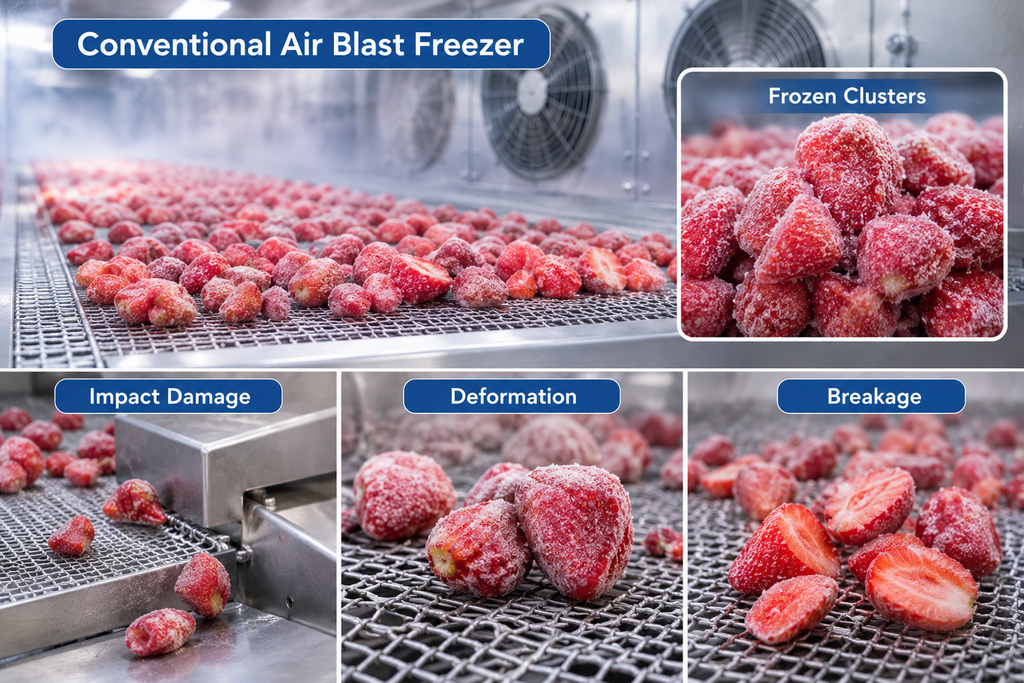
Conventional air blast freezers generally do not subject products to continuous mechanical agitation during freezing. This can reduce mechanical contact during the freezing stage, particularly for certain foods with delicate surfaces that are sensitive to impact.
However, this does not mean that conventional air blast freezers are free from product damage risks. Common contributing factors include:
- Excessive product stacking, which may cause compression or deformation.
- Impact at conveyor entrances, exits, and transfer points.
- Uneven freezing, resulting in differences in freezing conditions across the product load.
- Mechanical damage during loading, unloading, and manual handling.
- Product breakage during post-freezing separation when individual pieces have frozen together.
For delicate fruits such as strawberries and raspberries, mechanical separation may cause additional breakage if products form large frozen clusters.
2.2 Potential Product Damage in Fluidized Bed Freezers
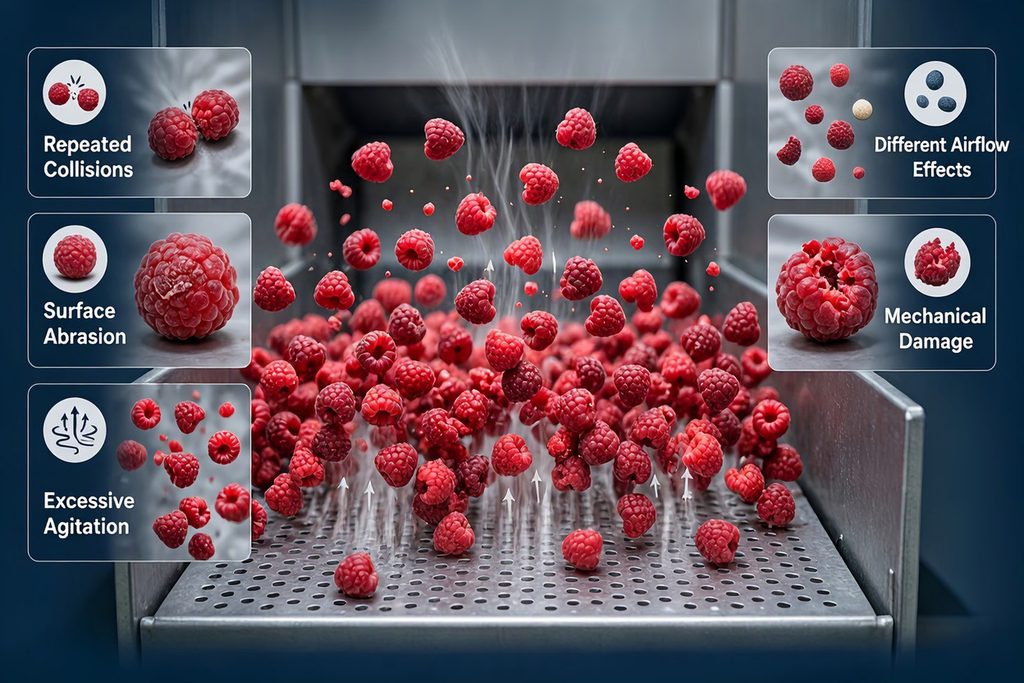
Fluidized bed freezers use continuous airflow to keep product particles moving, reducing prolonged contact between individual pieces and helping minimize product adhesion.
However, fluidization also introduces additional mechanical interactions that must be properly controlled.
Potential risks include:
- Repeated collisions between individual particles.
- Surface abrasion caused by continuous movement.
- Excessive agitation or product carryover due to overly strong airflow.
- Different airflow effects on products with varying sizes and densities.
- Mechanical damage to products with fragile structures.
Therefore, fluidized bed freezer design must balance particle suspension, airflow intensity, and mechanical interaction.
For delicate products such as raspberries and soft fruits, particular attention should be paid to airflow velocity, product loading, and movement conditions during freezing.
2.3 Which System Produces Less Product Damage?
Neither technology has an absolute advantage in product damage rates across all food applications.
Conventional air blast freezers may be more suitable for fragile, irregularly shaped, or impact-sensitive products because they generally involve less product movement during freezing.
Fluidized bed freezers are more suitable for small, relatively uniform particles that tend to stick together. Continuous particle movement helps reduce frozen clusters and the product losses associated with subsequent separation.
It is also important to distinguish mechanical damage from freezing-related quality losses. Product breakage, dehydration during freezing, and drip loss after thawing are different phenomena and should be evaluated separately.
3. Airflow Principles: The Key Engineering Differences Between the Two Technologies
Airflow organization is one of the most important engineering differences between conventional air blast freezing and fluidized bed freezing.
3.1 Conventional Air Blast Freezer: Forced Convection Heat Transfer
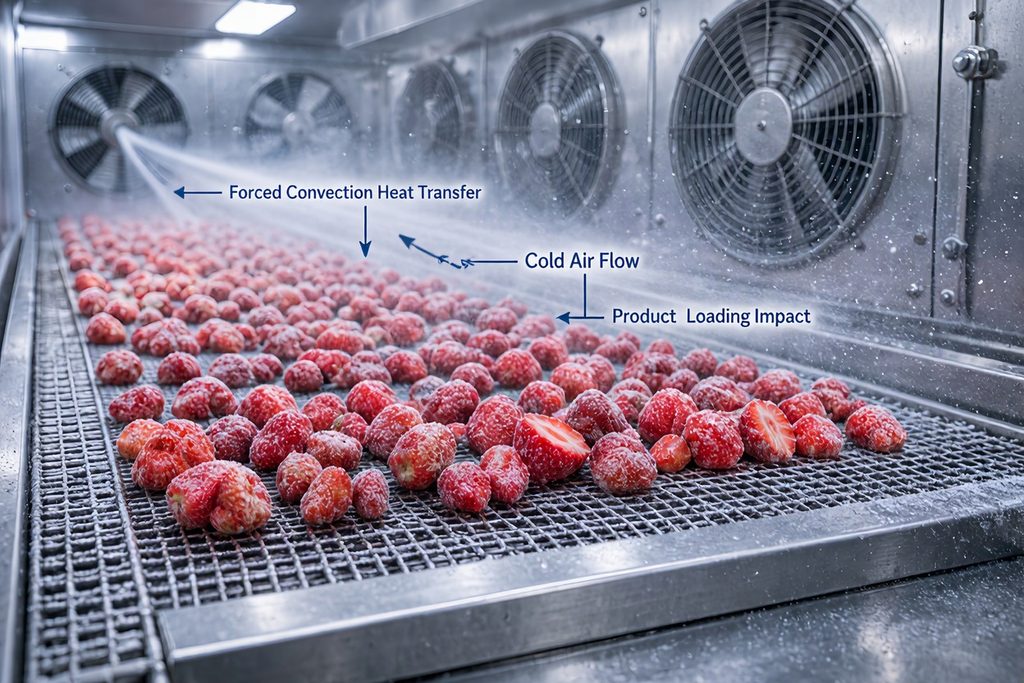
A conventional air blast freezer uses fans to circulate cold air throughout the freezing chamber. As the air passes over product surfaces, heat is removed through forced convection.
Heat transfer performance is primarily influenced by the following factors:
- Cold air temperature.
- Air velocity.
- Uniformity of air distribution.
- Product surface area.
- Product thickness and thermal properties.
- Airflow resistance caused by product loading.
Uneven airflow distribution within the freezing chamber may create localized temperature differences.
For example, products located in areas with lower air velocity may freeze more slowly, while densely loaded areas may restrict air circulation and reduce overall heat transfer performance.
Therefore, conventional air blast freezer design must consider not only fan airflow and static pressure but also the influence of product arrangement and loading patterns on air movement.
3.2 Fluidized Bed Freezer: Upward Airflow and Particle Suspension
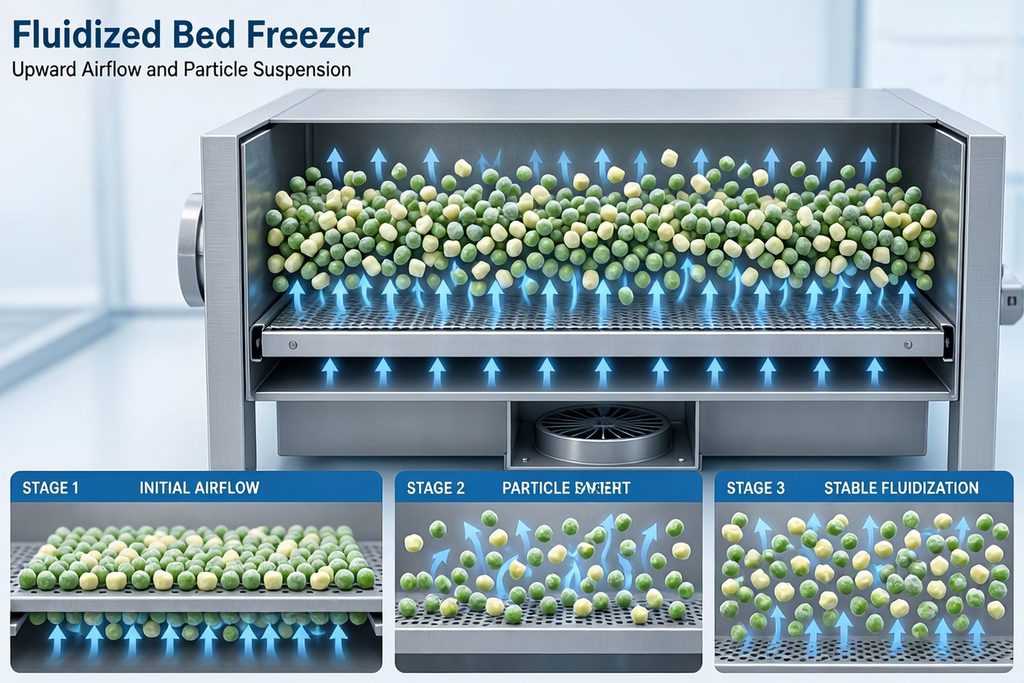
A fluidized bed freezer uses a different airflow arrangement.
Low-temperature air moves upward through a perforated conveyor belt or air distribution plate, passing through the product layer and the spaces between individual particles.
When airflow velocity reaches the minimum fluidization velocity, the upward aerodynamic force becomes sufficient to support the particles, causing the product bed to expand and begin moving.
The process can be divided into three stages:
Stage 1: Initial Airflow
Cold air enters the product layer through the perforated conveyor belt and passes through the gaps between individual particles, transferring heat from their surfaces.
Stage 2: Particle Movement
As airflow velocity increases, the aerodynamic force becomes stronger, causing particles to lift, move, and turn over. This reduces prolonged contact between individual pieces.
Stage 3: Stable Fluidization
Within an appropriate operating range, products remain suspended or continuously moving, exposing a greater proportion of their surfaces to cold air and improving heat transfer conditions.
Minimum fluidization velocity is influenced by particle size, density, shape, and product bed characteristics. Therefore, the same airflow velocity cannot be applied universally to all food products.
3.3 Why Is Airflow Distribution Design So Important?
In a fluidized bed freezer, insufficient airflow may prevent proper fluidization and result in uneven freezing. Excessive airflow, on the other hand, may cause excessive particle movement, collisions, or even product carryover from the conveying area.
For this reason, industrial fluidized bed freezers often incorporate multiple airflow zones, variable-frequency-controlled fans, and carefully designed air distribution chambers to regulate airflow across different sections of the product bed.
Some systems also divide the freezing process into an initial surface-freezing stage and a subsequent deep-freezing stage to accommodate different product freezing requirements.
For example, Yurnfreeze fluidized bed IQF freezer configurations use zoned freezing sections and variable-frequency fan control to adjust airflow according to product characteristics. This approach aims to maintain appropriate particle movement while considering heat transfer uniformity, mechanical damage, and dehydration control.
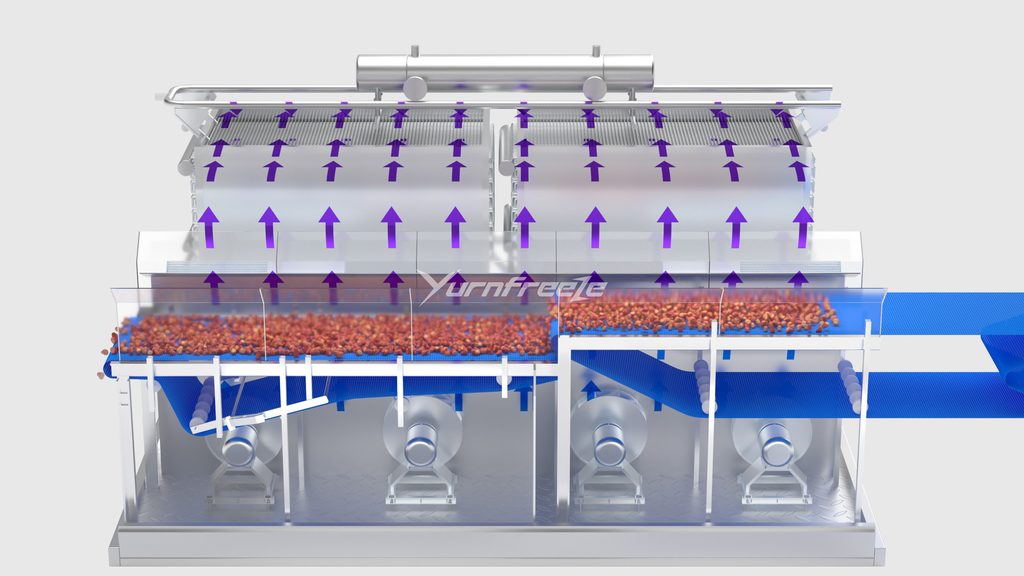
The engineering objective is to achieve stable fluidization rather than simply increasing airflow velocity.
4. Freezing Performance and Product Applications
The two technologies are suitable for different product characteristics and production requirements.
| Comparison Factor | Conventional Air Blast Freezer | Fluidized Bed Freezer |
|---|---|---|
| Product arrangement | Stationary or conveyor-based | Moving or suspended particles |
| Product separation | Depends on loading patterns and subsequent handling | Maintained through fluidization |
| Typical products | Meat, fish, bakery products, packaged foods, vegetables | Green peas, corn kernels, diced vegetables, berries, small seafood |
| Airflow direction | Horizontal, vertical, or cross-flow circulation | Primarily upward through the product bed |
| Product movement | Limited or conveyor-driven | Continuous particle movement |
| Product size requirements | Relatively flexible | Better suited to relatively uniform particles |
| Mechanical interaction | Generally limited during freezing | More particle-to-particle interaction |
| IQF suitability | Achievable with appropriate loading conditions | Specifically designed for many IQF particle applications |
Conventional air blast freezers offer greater flexibility in terms of product shape, size, and variety, making them suitable for processing a wide range of food products.
Fluidized bed freezers have a more specialized application range. Their technical advantages become more apparent when production lines need to continuously process large volumes of small, individual food particles while maintaining separation in the finished product.
5. How to Select the Appropriate Freezing Technology
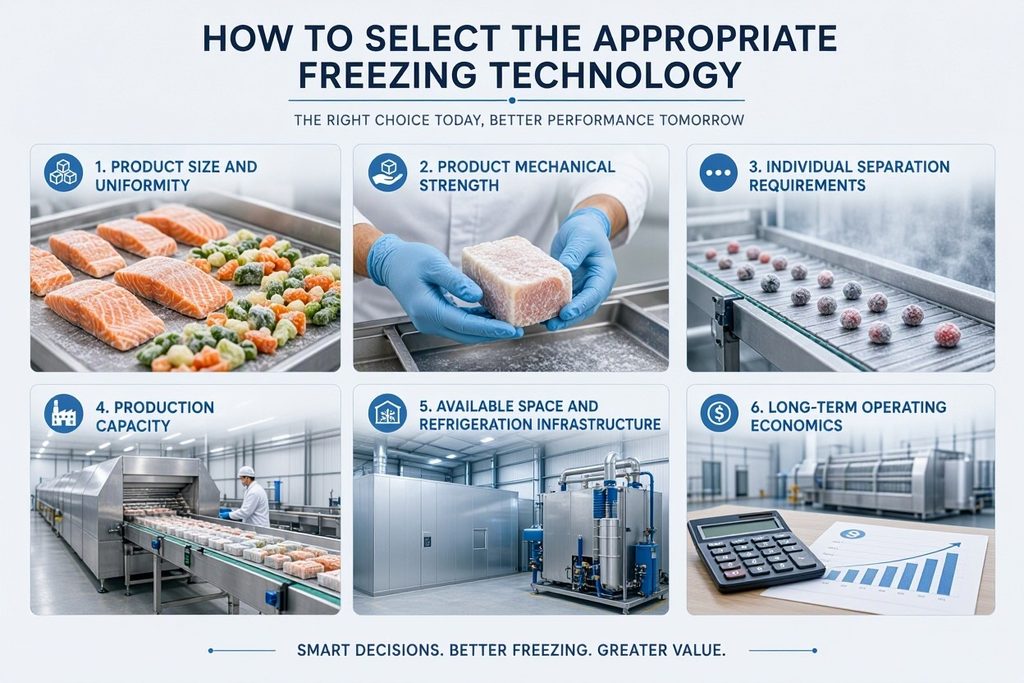
Equipment selection should begin with the physical characteristics of the product rather than the equipment category itself.
The following factors are particularly important:
1. Product Size and Uniformity
Fluidized bed freezing is generally more suitable for small particles with relatively uniform size and density. Large, irregularly shaped products or products with significant size variations may be difficult to fluidize consistently.
2. Product Mechanical Strength
If products are sensitive to impact or surface abrasion, the mechanical interactions that may occur during freezing should be carefully evaluated.
3. Individual Separation Requirements
If the finished product must remain individually separated and its physical characteristics are suitable for fluidization, fluidized bed freezing generally offers an advantage.
4. Production Capacity
Required throughput should be evaluated together with product loading density, freezing time, and equipment operating hours.
5. Available Space and Refrigeration Infrastructure
The freezer must be compatible with the factory layout, existing refrigeration system, electrical supply, and available maintenance access.
6. Long-Term Operating Economics
Energy consumption, product losses, cleaning time, labor requirements, and equipment maintenance costs should be evaluated together.
For products with uncertain freezing characteristics, actual product freezing trials are generally a reliable way to determine whether a fluidized bed system can meet the required product quality and production capacity.
Conclusion
Both conventional air blast freezers and fluidized bed freezers use forced cold air to remove heat from food products. However, differences in airflow organization and product movement result in distinct operating characteristics.
Conventional air blast freezers offer a broader range of applications and are generally more suitable for products with varying shapes and sizes, or products that require limited mechanical movement during freezing.
Fluidized bed freezers are more specialized systems, particularly suitable for small, relatively uniform food particles that need to maintain individual separation throughout the freezing process.
The appropriate technology should ultimately be selected based on product characteristics, freezing requirements, production capacity, and long-term operating economics. Neither technology should be considered universally more efficient across all food processing applications.
FAQ
1. Can a conventional air blast freezer achieve IQF results?
Yes. A conventional air blast freezer can achieve individual quick freezing by properly controlling product spacing, loading density, airflow distribution, and freezing conditions. However, maintaining separation during freezing may be more challenging for small products that tend to stick together.
2. Why does a fluidized bed freezer help prevent products from freezing together?
A fluidized bed freezer uses upward-moving cold air to partially or fully suspend small food particles. Continuous particle movement reduces prolonged contact between individual pieces, lowering the likelihood of products freezing together.
3. Are all fruits and vegetables suitable for fluidized bed freezing?
No. Fluidized bed freezers are generally more suitable for small particles with relatively uniform size, density, and mechanical strength. Large, irregularly shaped, or highly fragile fruits and vegetables may require alternative freezing methods or specialized airflow and conveying designs.
4. Does a fluidized bed freezer consume less energy than a conventional air blast freezer?
Not necessarily. Energy consumption depends on fan power, refrigeration load, airflow resistance, product throughput, freezing time, and actual operating conditions. A meaningful comparison should evaluate both systems using the same product, throughput, and freezing requirements.