
Abstract: The thermodynamic performance and energy footprint of industrial rapid freezing equipment are contingent upon multiple variables, including compressor efficacy, inlet product enthalpy/temperature, cold chamber environmental parameters, airflow uniformity, and overall heat exchanger effectiveness. This research elucidates the coupling mechanisms between refrigeration cycle operation and food freezing processes. Based on this analysis, critical factors influencing specific energy consumption (SEC) are identified, and systematic optimization approaches are formulated to mitigate energy intensity per unit of frozen product.
Introduction
In industrial food freezing applications, equipment is typically selected based on key parameters such as refrigeration capacity, production throughput, and operating temperature. However, these specifications alone do not provide a complete picture of the equipment’s actual energy efficiency.
The actual energy consumption of a freezing system is influenced by multiple interrelated factors, including compressor operating efficiency, product inlet temperature, ambient conditions, airflow distribution, and heat transfer performance.
Even when a refrigeration unit operates at a high level of efficiency, the overall system may still consume excessive electricity if products enter the freezing process at excessively high temperatures, airflow is poorly distributed, or evaporator coils experience significant frost accumulation.
Therefore, understanding the energy consumption profile of industrial freezing equipment is essential for food processing companies seeking to identify sources of energy waste and develop more effective operational optimization strategies.
1. Where Does the Electricity Go in an Industrial Freezing System?
The electricity used by an industrial freezing system is mainly consumed by the following components:
Refrigeration Compressors: Compressors provide the cooling capacity required by the system. Their main function is to remove heat from the products and the freezing system.
Evaporator Fans: These fans circulate cold air throughout the freezing area, ensuring effective heat transfer between the air, the products, and the evaporator surfaces.
Conveyor System: Conveyor belts and drive motors transport products continuously through the freezing zone.
Defrost System: The defrost system removes frost and ice from the evaporator coils, helping to maintain normal heat transfer performance.
Auxiliary Equipment: This includes refrigeration pumps, control systems, lighting, and other supporting equipment.
In conventional industrial freezing systems that use mechanical refrigeration, the compressor is generally the largest electricity-consuming component . However, its actual share of total energy consumption varies depending on the system design, operating conditions, refrigerant type, and production load.
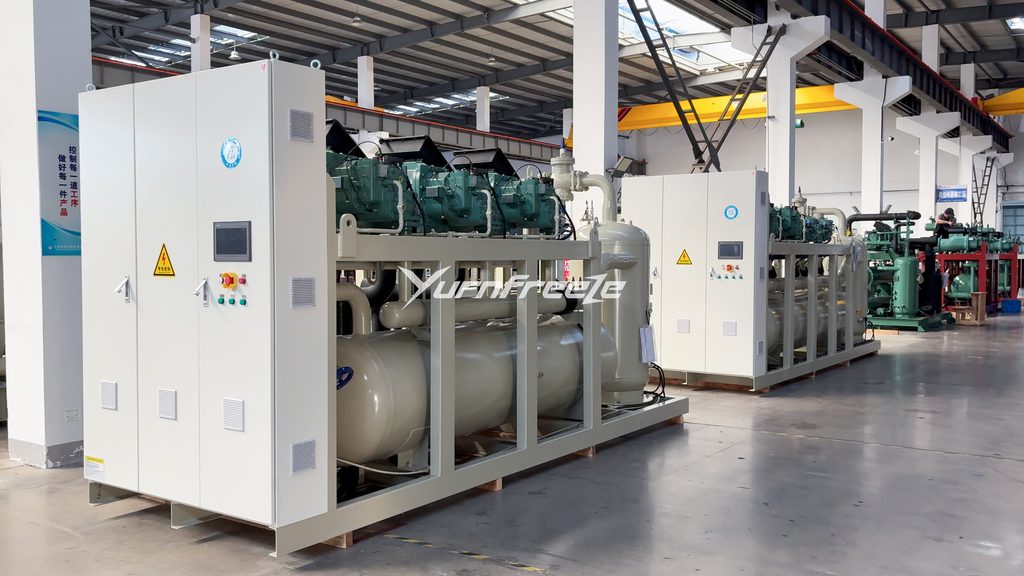
For this reason, a fixed percentage should not be used to estimate compressor energy consumption across all industrial freezing systems.
One of the most important factors affecting compressor energy consumption is the temperature difference between the evaporating temperature and the condensing temperature. This is commonly known as the temperature lift.
When the evaporating temperature decreases or the condensing temperature increases, the compressor generally needs to use more electricity to deliver the same amount of cooling capacity.
This means that improving energy efficiency is not simply a matter of selecting a more efficient compressor. The operating conditions and overall performance of the entire refrigeration system must also be taken into account.
2. How Does Product Inlet Temperature Affect Freezing Energy Consumption?
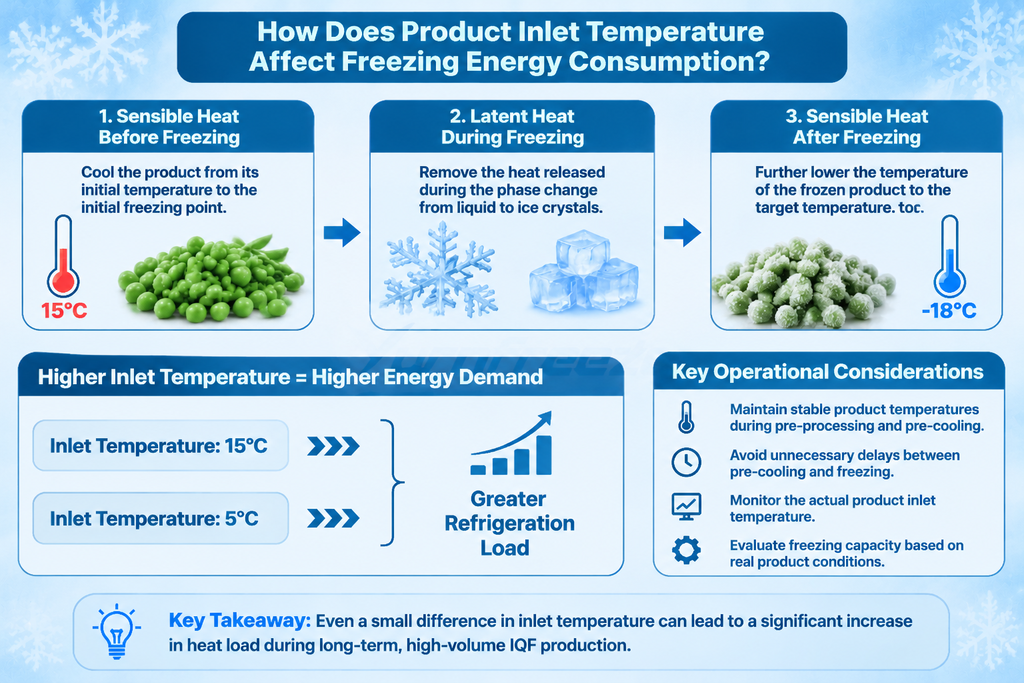
Product inlet temperature is one of the most direct factors affecting energy consumption in industrial freezing processes.
To freeze a food product from its initial temperature to the target temperature, the refrigeration system must remove three types of heat:
1. Sensible Heat Before Freezing: The heat removed to cool the product from its initial temperature to its initial freezing point.
2. Latent Heat During Freezing: The heat that must be removed during the phase change, as water in the product changes from a liquid state into ice crystals.
3. Sensible Heat After Freezing: The additional heat removed to further lower the temperature of the frozen product to the required discharge temperature.
The total heat load can be expressed as:
Q = Q_{\text{Sensible, 1}} + Q_{\text{Latent}} + Q_{\text{Sensible, 2}}
When products enter a freezing system at a higher temperature, the refrigeration system must remove more sensible heat to complete the freezing process.
For example, assuming the product mass, composition, and final freezing temperature remain the same, vegetables entering the freezing system at 15°C require a greater refrigeration load than the same type of vegetables entering at 5°C.
This additional heat load may increase compressor operating time and electricity consumption. When the equipment is operating close to its designed capacity, it may also affect the actual production throughput.
Key Operational Considerations:
- Maintain stable product temperatures during pre-processing and pre-cooling.
- Avoid unnecessary delays between pre-cooling and the freezing process.
- Monitor the actual product inlet temperature rather than relying solely on the ambient temperature of the processing area.
- Evaluate freezing capacity based on actual product temperatures and processing throughput.
For continuous Individual Quick Freezing (IQF) production lines, even a temperature difference of just a few degrees Celsius at the product inlet can result in a significant additional heat load over extended production periods and at high processing volumes.
3. How Do Cold Storage Facilities and Surrounding Conditions Affect Freezing Energy Efficiency?
Quick-freezing equipment does not operate as an isolated refrigeration unit. Its surrounding environment and supporting refrigeration infrastructure also play an important role in determining overall energy consumption.
Several environmental factors can increase the refrigeration load:
Ambient Temperature: Higher outdoor or production-area temperatures increase heat transfer through the cold storage enclosure, including walls, floors, ceilings, and doors.
Door Opening Frequency: Frequent cold storage door openings allow warm, humid air to enter low-temperature areas, increasing both sensible and latent heat loads.
Insulation Performance: Damaged insulation, thermal bridges, and poor sealing increase heat infiltration into the cold storage area.
Evaporator Frost Formation: Moisture entering refrigeration areas with humid air may accumulate as frost on evaporator surfaces, restricting airflow and reducing heat transfer efficiency.
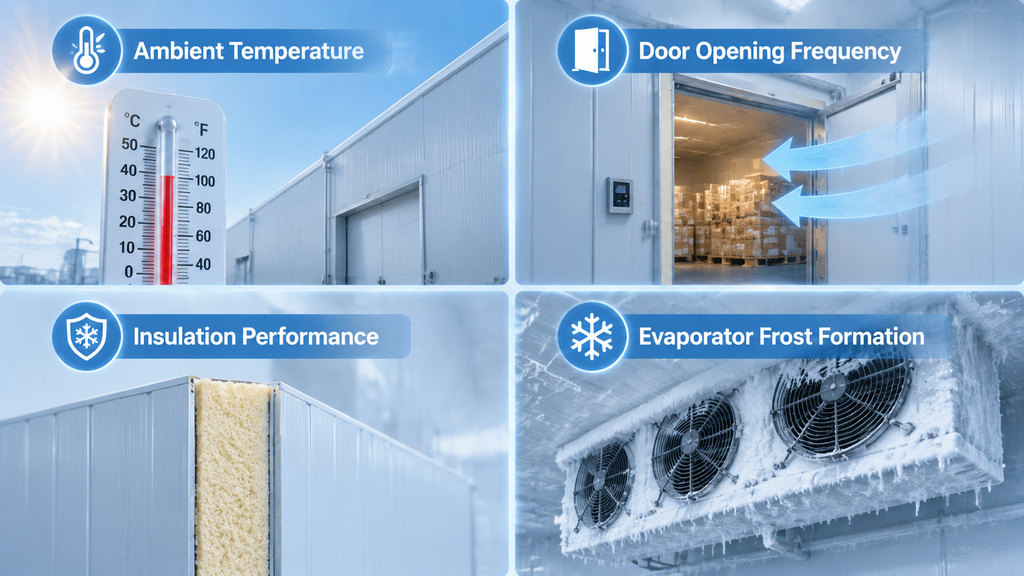
These factors can increase refrigeration demand or alter condensing and evaporating temperatures, ultimately leading to higher compressor power consumption.
For example, excessive frost accumulation on evaporator surfaces can increase airflow resistance and reduce heat exchange capacity. As a result, the refrigeration system may need to operate for longer periods to maintain the target temperature. Additional defrost cycles also consume energy and may temporarily interrupt normal refrigeration operation.
Therefore, when evaluating the operating energy efficiency of industrial quick-freezing equipment, it is important to consider the surrounding cold storage environment and supporting refrigeration infrastructure, rather than assessing the freezer as an independent piece of equipment.
4. The Relationship Between Air Velocity and Heat Transfer Efficiency
In air-blast freezing equipment, airflow distribution is one of the key factors affecting freezing efficiency. This is particularly important for fluidized-bed IQF freezers, spiral freezers, and tunnel freezers.
The convective heat transfer coefficient between a product and the surrounding cold air directly determines how quickly heat can be removed from the product surface.
In general, increasing air velocity helps reduce the thickness of the thermal boundary layer around the product, thereby enhancing convective heat transfer.
However, this does not mean that higher air velocity always leads to better overall system energy efficiency.
On the one hand, increasing fan speed raises motor power consumption. On the other hand, if airflow distribution is poorly designed or internal duct resistance is excessive, the additional airflow may not deliver a proportional improvement in freezing performance.
The relationship between these factors can be understood through three key aspects:
Heat Transfer Efficiency: Appropriate air velocity enhances convective heat transfer at the product surface, helping shorten freezing time.
Fan Energy Consumption: Increasing airflow generally requires greater fan power, particularly when the system has high airflow resistance.
Airflow Distribution: Uniform and well-designed airflow helps ensure consistent heat transfer across the product layer, reducing variations in freezing performance.
Therefore, the primary objective in industrial refrigeration system design is not simply to achieve the highest possible air velocity, but to establish an appropriate and uniform airflow distribution while meeting the product’s freezing requirements.
This is particularly important for fluidized-bed freezers. The equipment must generate sufficient airflow velocity to suspend and fluidize individual food particles while avoiding excessive product movement and uneven freezing.
Taking Yurnfreeze Fluidized-Bed IQF Freezers as an example, the equipment uses a combination of a dual-air-chamber structure and optimized airflow channels. Driven by fans, low-temperature air flows upward through the conveyor belt and product layer, allowing individual food particles to reach a fluidized state under controlled airflow conditions.
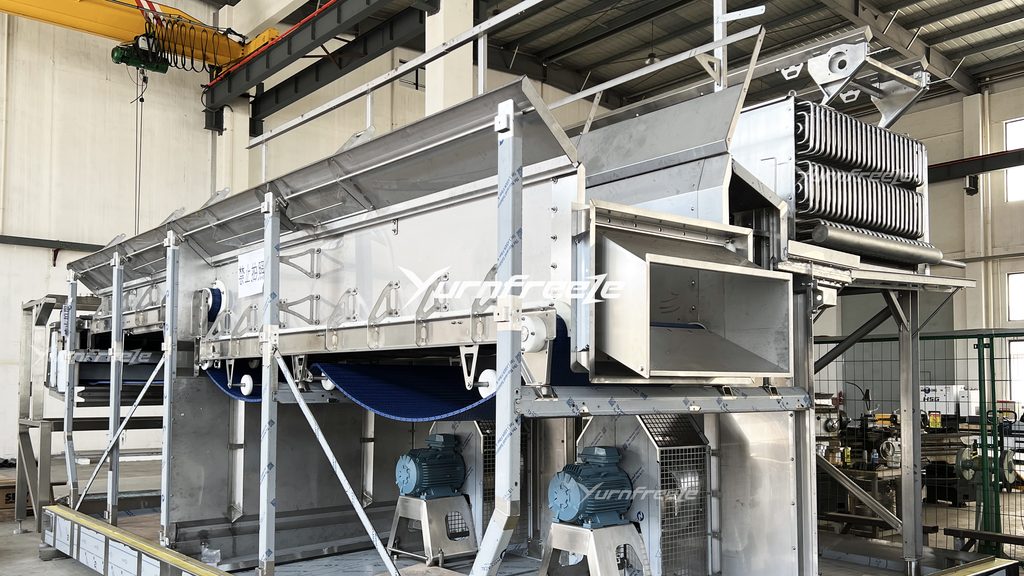
From an energy efficiency perspective, the purpose of the dual-air-chamber structure, optimized airflow channels, and variable-frequency control is not simply to increase air velocity. Instead, these design features aim to minimize unnecessary air circulation and avoid excessive fan power consumption while maintaining the airflow conditions required for product fluidization and freezing.
At the same time, properly distributed airflow helps reduce freezing variations between products in different areas of the equipment, preventing localized insufficient heat transfer from extending the overall freezing time.
5. How to Balance Freezing Efficiency and Energy Consumption?
The factors discussed above are interrelated. Optimizing an individual component does not necessarily result in a significant reduction in the overall energy consumption of the system.
For example:
- Increasing Fan Speed: May shorten freezing time, but it also increases fan power consumption.
- Lowering Evaporating Temperature: May improve low-temperature refrigeration performance, but generally increases compressor power consumption.
- Increasing Production Throughput: May improve equipment utilization, but also increases the instantaneous refrigeration load.
- Reducing Defrost Frequency: May temporarily reduce energy consumption, but excessive frost accumulation can ultimately decrease heat transfer efficiency.
Therefore, evaluating the energy efficiency of quick-freezing equipment requires consideration of actual operating and production data, rather than focusing solely on the rated specifications of individual components.
One commonly used performance indicator is Specific Energy Consumption (SEC), which measures the amount of electricity consumed per unit of product processed:
SEC = \frac{\text{Total Electricity Consumption (kWh)}}{\text{Product Throughput (tonnes)}}
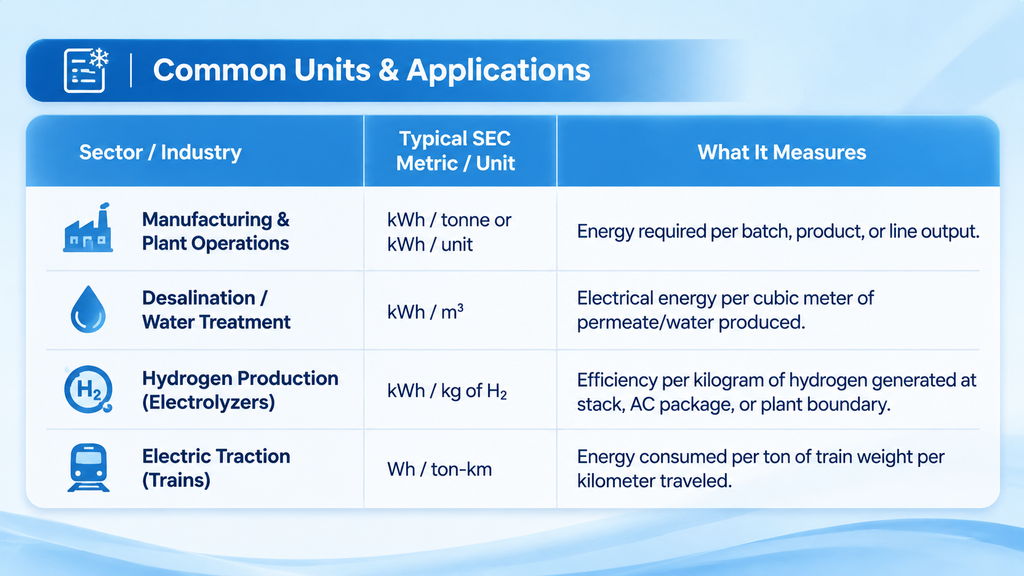
The result is typically expressed in kWh/tonne.
To ensure that comparisons between different pieces of equipment or operating conditions are meaningful, the following parameters should be kept as consistent as possible during the measurement period:
- Product type and specifications
- Product inlet temperature
- Final product discharge temperature
- Actual production throughput
- Equipment operating time
In addition, it is important to distinguish between the electricity consumption of the quick-freezing equipment itself and the total electricity consumption of the entire refrigeration plant. These two measurements have different system boundaries and should not be directly compared or used interchangeably.
Conclusion
The energy efficiency of industrial quick-freezing equipment depends on more than compressor specifications or rated cooling capacity. Compressor operating conditions, product inlet temperature, cold storage environment, and airflow distribution all contribute to overall energy consumption.
For food processing businesses, effective energy assessment requires evaluating the entire freezing process, identifying additional heat loads, and measuring electricity consumption against actual production throughput. A system-wide approach provides a more reliable basis for improving freezing efficiency and controlling long-term operating costs.
FAQ
1. Can an existing refrigeration system support an additional industrial IQF freezer?
Not necessarily. Existing refrigeration capacity may not be sufficient to handle the additional load. Key factors include compressor capacity, refrigerant type, evaporating temperature, refrigerant supply, peak load, and compatibility with existing piping and control systems.
2. Why does freezer energy consumption increase when production output remains unchanged?
Check operating conditions, including evaporator frost buildup, fan performance, refrigerant supply, condenser cleanliness, compressor operating pressure, and door sealing. Also verify whether product inlet temperatures or freezing requirements have changed. Comparing current data with historical records helps identify the cause.
3. Is continuous operation more energy-efficient than frequent start-ups and shutdowns?
For stable, continuous production, consistent operation can reduce energy losses associated with frequent start-ups and shutdowns. However, running at full capacity during periods of low demand may waste energy. The operating strategy should match production schedules and actual refrigeration requirements.
4. Should energy consumption be the primary consideration when replacing an old freezer?
Energy consumption is important, but it should not be the only selection criterion. Production capacity, installation space, product specifications, freezing requirements, and compatibility with existing refrigeration infrastructure must also be considered.
Yurnfreeze provides replacement and upgrade solutions for aging industrial freezers. Engineering assessments cover equipment dimensions, internal structure, production capacity, conveyor systems, product infeed and discharge positions, and refrigeration connections. Through on-site measurements and technical evaluations, we help determine installation feasibility while minimizing modifications to existing production layouts and supporting infrastructure.
References and Further Reading
The following resources provide additional technical information on industrial refrigeration energy efficiency, food-freezing loads, and refrigeration system optimization.
- Good Practice Guide – Industrial Refrigeration
Energy Efficiency and Conservation Authority (EECA). Covers industrial refrigeration efficiency, compressor operation, temperature lift, evaporator performance, and defrost management. - Chapter 29: Industrial Food-Freezing Systems
ASHRAE Handbook. Explains the thermodynamic principles of industrial food-freezing systems and related freezing processes. - Chapter 24: Refrigerated-Facility Loads
ASHRAE Handbook. Covers refrigeration loads, product heat loads, heat transfer through building envelopes, and air infiltration in refrigerated facilities. - Refrigeration – Equipment and Energy Efficiency
Australian Government. Provides guidance on refrigeration equipment, compressor controls, temperature settings, and defrost optimization. - Energy Efficiency Opportunities in Industrial Refrigeration
US Environmental Protection Agency (EPA). Discusses energy-saving opportunities in industrial refrigeration systems, including condensing pressure control and compressor energy optimization.