
Introduction
Individual Quick Freezing (IQF) is a widely used freezing technology in modern food processing, particularly for products that need to retain their individual shape, structural integrity, and separation after freezing.
Unlike conventional block freezing, IQF aims to freeze individual food pieces within a relatively short period, reducing the likelihood of products forming large frozen masses that are difficult to separate. The technology is widely applied in fruit and vegetable processing, seafood production, and meat and poultry manufacturing.
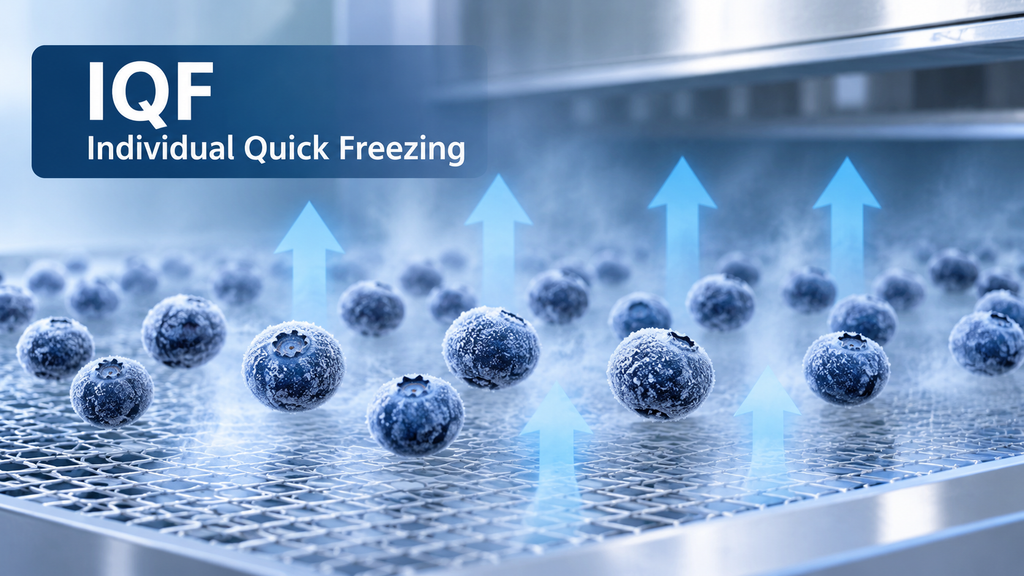
However, different food products vary considerably in their suitability for IQF processing. Product dimensions, moisture content, surface conditions, internal structure, and composition all influence freezing rates, the risk of product adhesion, and final product quality.
Understanding these physical characteristics and their interaction with freezing conditions is essential for selecting appropriate IQF technology and optimizing industrial freezing operations.
1. Applications of IQF Across Different Food Categories
IQF technology is widely used across several food processing sectors. However, its suitability for individual products depends on their physical characteristics and processing requirements.
1.1 Fruits and Vegetables
Fruits and vegetables are among the most established applications of IQF technology. Common products include:
- Peas, sweet corn, diced carrots, and green beans
- Broccoli, cauliflower, and diced onions
- Blueberries, strawberries, mango chunks, and peach pieces
- Potato products and other processed vegetables
Fluidized-bed freezing is generally well suited to small, relatively uniform vegetables. The equipment uses upward-directed cold air to suspend or fluidize individual pieces, increasing air-to-product contact and improving heat transfer.
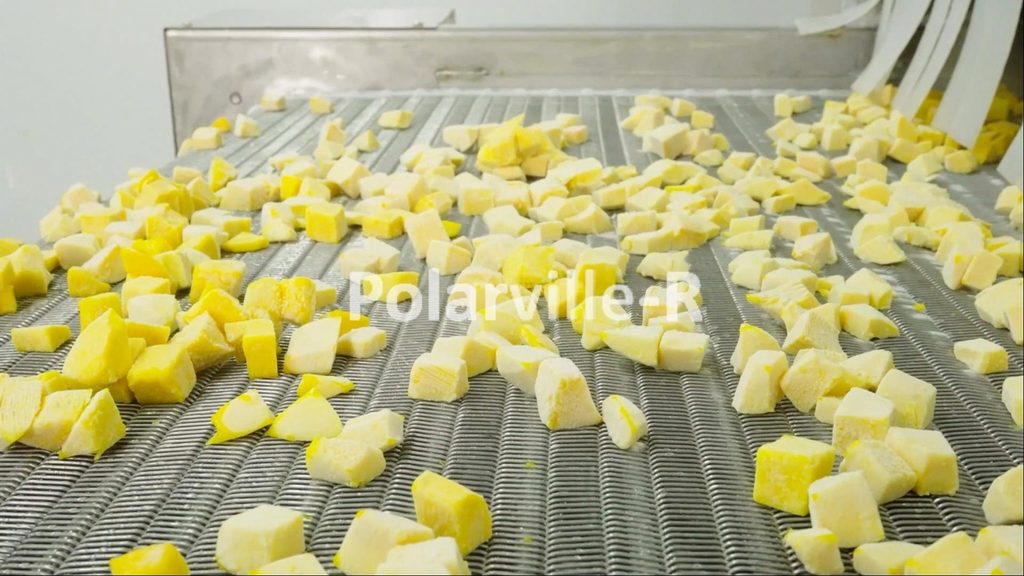
This approach is particularly useful for products that tend to stick together during freezing.
Fruits require additional consideration because of their cellular structure and mechanical strength. Some fruits have relatively high surface moisture and delicate internal structures, making them more susceptible to mechanical damage and product adhesion during freezing.
For example, strawberries and raspberries require relatively gentle handling and carefully controlled airflow. Excessive airflow may cause unnecessary product movement or collisions, while insufficient airflow can result in uneven freezing.
The soluble sugar content of fruits also affects their freezing behavior by lowering their initial freezing point. Consequently, different fruits may require different residence times and operating conditions, even when their dimensions are similar.
1.2 Seafood
Seafood is another major application area for IQF technology, particularly for:
- Peeled shrimp and prawns
- Scallop meat and mussel meat
- Fish fillets and fish portions
- Squid rings and diced squid
- Small whole fish and other individually portioned seafood products
One of the main advantages of IQF in seafood processing is its ability to maintain individual pieces after freezing rather than producing a solid frozen mass.
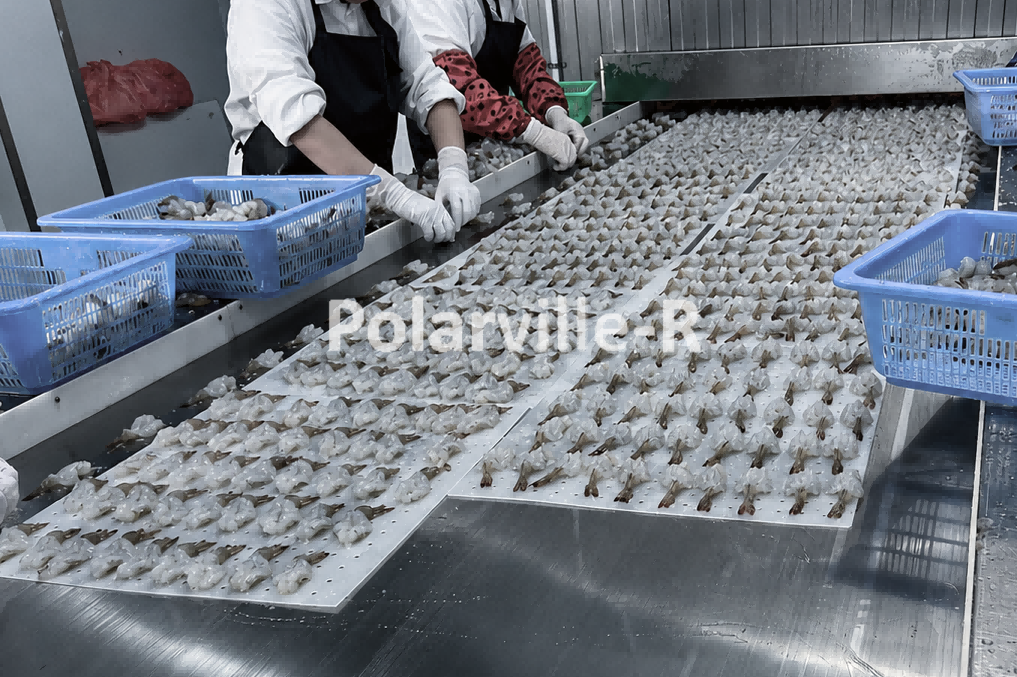
However, seafood products also present specific processing challenges.
Peeled shrimp, for example, can retain considerable surface moisture after washing. If the products are not adequately drained before entering the freezer, residual water between adjacent pieces may form ice bridges, causing multiple shrimp to freeze together.
Seafood products also vary significantly in shape, thickness, and composition. Shrimp, scallops, and fish fillets therefore cannot necessarily be processed under identical freezing conditions.
For smaller, relatively uniform seafood products, fluidized-bed freezing can improve individual separation. Larger or irregularly shaped products may be better suited to mesh-belt or spiral freezing systems, depending on product dimensions and production requirements.
For certain seafood products, glazing may also be applied after freezing to form a protective ice layer on the surface, helping reduce moisture loss during frozen storage.
1.3 Meat and Poultry
IQF technology is increasingly used in meat and poultry processing, particularly for products that require individual separation and subsequent portion control.
Typical applications include:
- Diced chicken and poultry portions
- Chicken nuggets and breaded chicken fillets
- Diced beef and pork
- Meatballs and formed meat products
- Cooked or partially processed meat ingredients
Compared with many vegetables, meat products have more complex internal structures, typically containing varying proportions of muscle tissue, fat, connective tissue, and water.
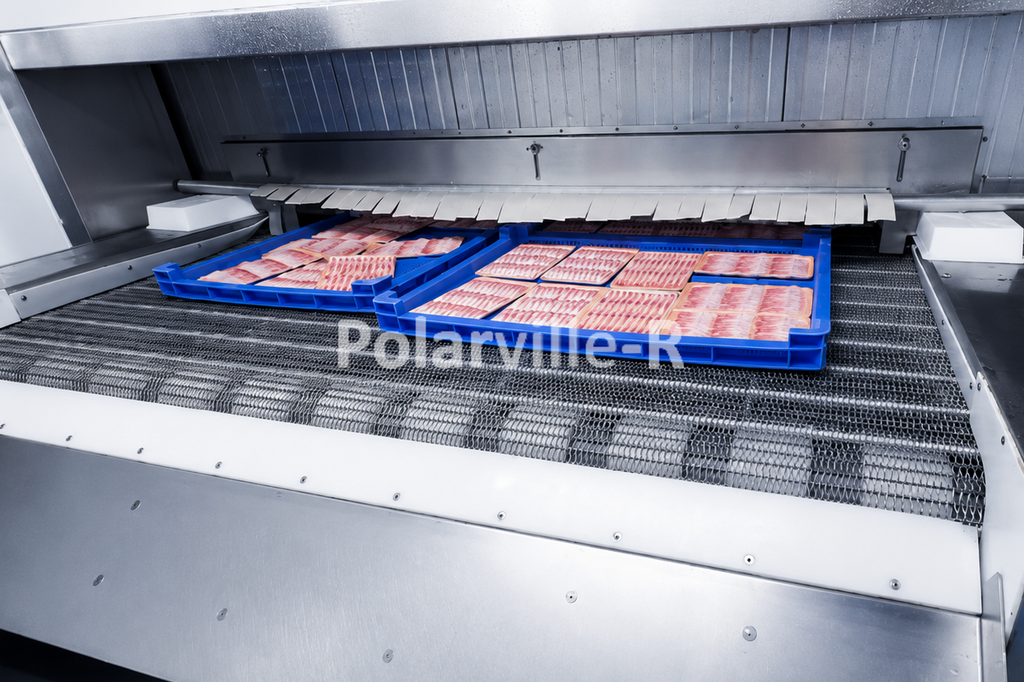
These differences influence thermal conductivity, freezing behavior, and final product quality.
For example, small diced chicken pieces can be processed using suitable IQF systems, whereas larger formed meat products generally require longer freezing times and may need different conveying arrangements.
Surface coatings introduce another important consideration. Breaded chicken products may retain moisture within their coating layers. If adjacent pieces come into excessive contact before the coating has sufficiently stabilized, adhesion or coating damage may occur.
Therefore, freezing operations need to consider not only the target core temperature but also coating stability, product handling, and the degree of contact between individual pieces.
Industrial Application Example: Self-Stacking Spiral Freezing of Breaded Chicken in Australia
In an Australian food processing project associated with SushiAri / Young Food, Yurnfreeze supplied a self-stacking spiral freezer for processing breaded chicken schnitzels and chicken portions. The system was designed for a processing capacity of 1,000–1,500 kg/h, with a product inlet temperature of approximately +15°C, an operating temperature of -35°C, and a target product discharge temperature of -18°C. The system was designed to achieve the specified freezing targets during continuous operation.
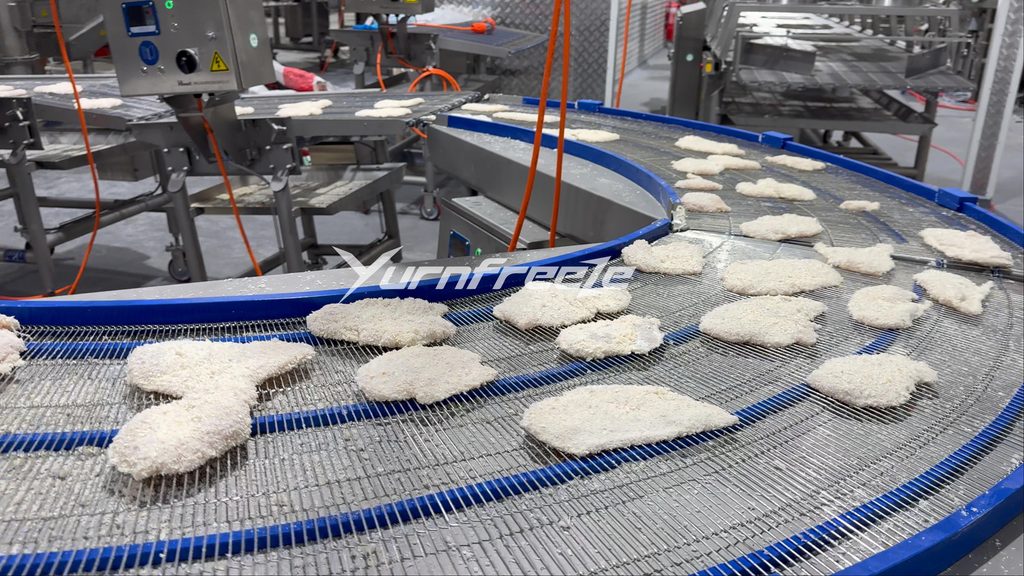
Project reference: Yurnfreeze – Self-Stacking Spiral Freezer for Australia
This application illustrates the suitability of self-stacking spiral technology for breaded poultry products through several engineering considerations:
- Reduced reliance on fluidization: Unlike fluidized-bed freezers, self-stacking spiral systems support products on a conveyor belt rather than relying on strong upward airflow to suspend individual pieces. This makes the configuration more suitable for products with larger dimensions, greater weight, and delicate breaded coatings.
- Improved continuous conveying: The self-stacking conveyor arrangement uses multiple vertically arranged tiers to provide continuous freezing. This allows relatively high processing capacity while reducing the floor space required by conventional long horizontal conveying systems.
- Consideration of product integrity and freezing requirements: For breaded chicken products, appropriate conveyor support, product spacing, and airflow distribution can help minimize unnecessary mechanical disturbance while providing conditions for more uniform freezing.
This project demonstrates that selecting a freezing system for breaded poultry involves more than meeting the required freezing capacity. Product surface characteristics, conveying stability, mechanical contact, and production throughput must also be considered.
It is important to note that the actual reduction in product adhesion depends on the combined effects of breading conditions, surface moisture, product loading, and freezing parameters.
2. Why Do Food Products Stick Together During IQF Freezing?
Product adhesion is one of the common processing challenges in IQF operations.
It primarily occurs when moisture on adjacent product surfaces freezes and forms ice bridges, connecting individual pieces that would otherwise remain separate.
Several factors contribute to this phenomenon.
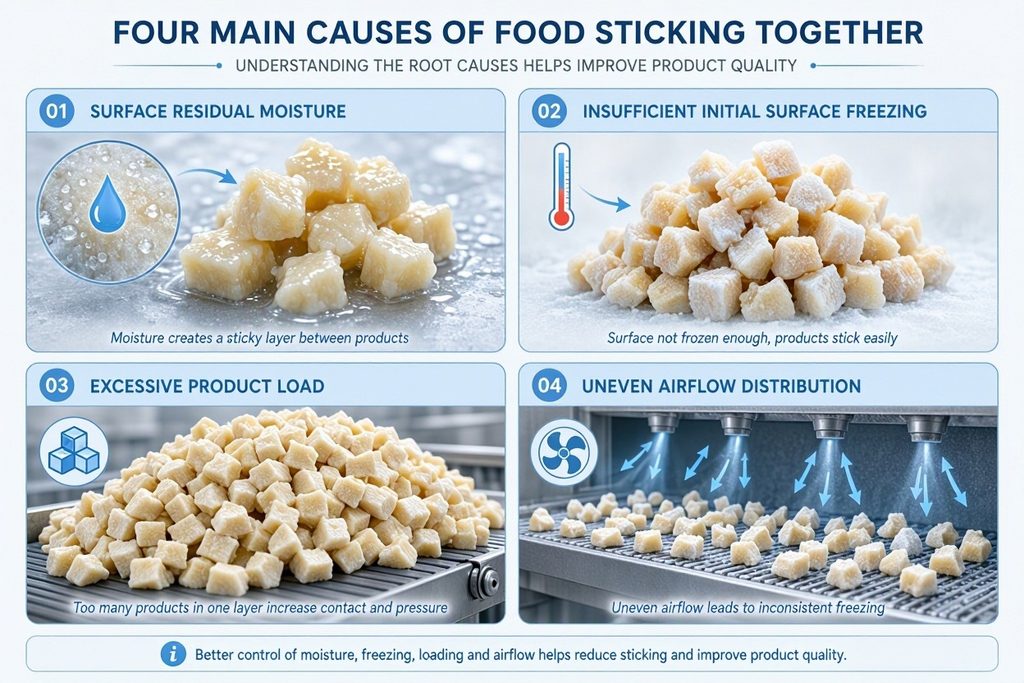
2.1 Surface Moisture
Water remaining on products after washing, thawing, or blanching may freeze between adjacent pieces and form ice bridges. This issue is particularly common in peeled shrimp, diced vegetables, and freshly cut fruits.
2.2 Insufficient Initial Surface Freezing
If the product surface does not freeze quickly enough to form a stable outer layer, adjacent pieces may remain in contact during the freezing process, increasing the likelihood of ice bridge formation.
2.3 Excessive Product Loading
When too much product is loaded onto a given conveyor area, individual pieces may overlap or accumulate in layers. This reduces exposure to cold air and increases the likelihood of contact between adjacent products.
2.4 Uneven Airflow Distribution
Poorly designed airflow channels may create localized areas with insufficient heat transfer. As a result, some products may freeze rapidly while others remain partially unfrozen.
2.5 Practical Approaches to Reducing Product Adhesion
Several process and equipment adjustments can help address these challenges:
- Control surface moisture before freezing. Appropriate draining, dewatering, or air-drying processes can reduce free moisture on product surfaces.
- Improve initial surface freezing. Rapid surface freezing helps stabilize the outer layer and reduce the likelihood of adhesion between individual pieces.
- Control product loading density. Proper product distribution helps prevent excessive accumulation and allows sufficient airflow around individual pieces.
- Optimize airflow velocity. Airflow should provide adequate heat transfer and, where necessary, fluidization without causing excessive product movement or mechanical damage.
- Adopt staged freezing. Separating initial surface freezing from subsequent deep freezing can improve product separation and freezing consistency.
Fluidized-bed IQF systems use upward-directed cold air to move and separate small food particles. This principle is particularly useful for products that tend to agglomerate during freezing.
A two-stage freezing configuration can further improve this process. The first section primarily performs rapid surface freezing, while the second provides sufficient residence time to bring the product core to the required temperature without maintaining the same degree of fluidization throughout the entire freezing process.
3. How Does Moisture Content Affect IQF Freezing Performance?
Moisture content is an important factor in food freezing, but its influence extends beyond the amount of water that needs to be frozen.
Even two food products with similar total moisture content may exhibit different freezing characteristics because of variations in water distribution, soluble solids, surface moisture, and cellular structure.
3.1 High-Moisture Foods
Many fruits, vegetables, and seafood products have relatively high moisture content.
Typical examples include:
- Strawberries and blueberries
- Watermelon and mango
- Cucumbers and certain leafy vegetables
- Shrimp and scallops
A higher moisture content means that a considerable amount of latent heat must be removed during freezing.
For products with delicate cellular structures, rapid heat removal is particularly important. Longer freezing times may promote the formation and growth of larger ice crystals, potentially damaging cell structures and increasing drip loss during subsequent thawing.
However, high moisture content does not necessarily mean that a product is difficult to freeze individually. In practical processing, surface moisture, product geometry, and handling methods may have a more direct influence on whether adjacent pieces stick together.
3.2 Lower-Moisture or Higher-Solids Foods
Some processed foods contain a lower proportion of free water or a relatively high proportion of sugars, fats, carbohydrates, and other solids.
Examples include:
- Breaded meat products
- Certain processed potato products
- Bakery ingredients
- Formulated and formed food products
Dissolved substances such as sugars and salts lower the freezing point of food. As a result, some water remains unfrozen at temperatures below the freezing point of pure water.
Fat content and internal product structure also influence heat transfer.
Consequently, products with similar dimensions but different compositions may require different residence times to reach the same target core temperature.
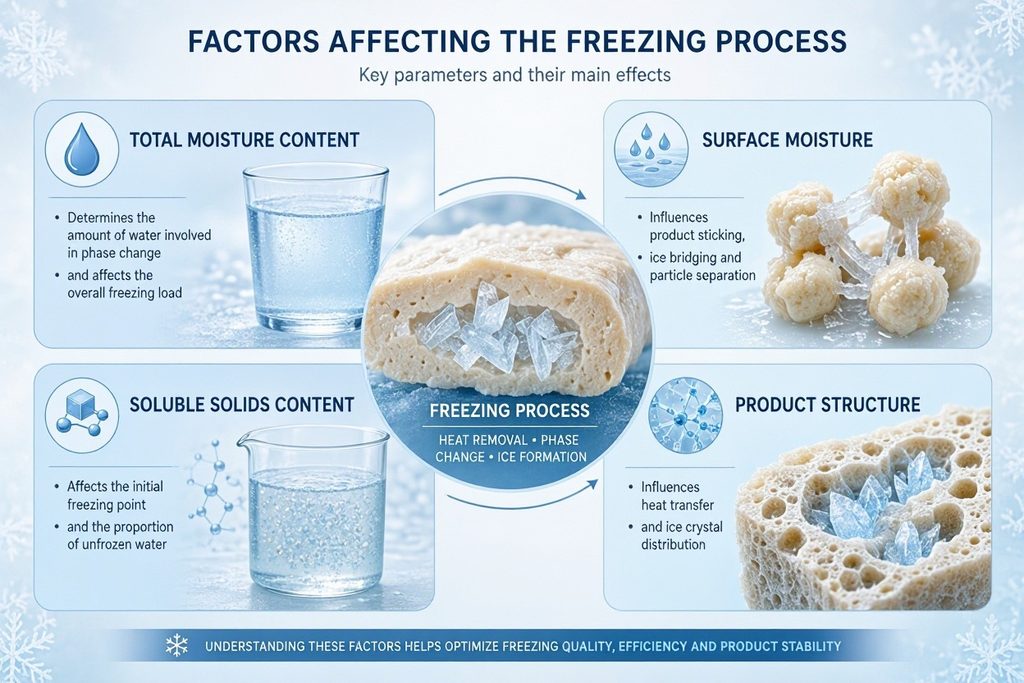
3.3 Total Moisture Content vs. Surface Moisture
In IQF process analysis, it is important to distinguish between two different moisture-related characteristics:
| Parameter | Main Influence on Freezing |
|---|---|
| Total moisture content | Determines the amount of water involved in phase change and contributes to the overall freezing load |
| Surface moisture | Influences product adhesion, ice bridge formation, and individual separation |
| Soluble solids | Affect the initial freezing point and the proportion of unfrozen water |
| Product structure | Influences heat transfer and ice crystal distribution |
In practical IQF operations, controlling surface moisture can be just as important as understanding the total moisture content of a product.
For example, two batches of diced carrots may have almost identical total moisture content, but a batch entering the freezer immediately after washing may retain more surface water. Without adequate drainage, the risk of adhesion between individual pieces may increase.
4. How to Match IQF Equipment to Product Characteristics
The suitability of IQF equipment primarily depends on product dimensions, mechanical strength, surface conditions, and required production capacity.
Different freezing configurations address different processing requirements.
| Freezing Configuration | Typical Applications | Main Consideration |
|---|---|---|
| Fluidized-bed IQF freezer | Peas, corn, diced carrots, berries, small shrimp | Suitable for products that can be suspended or effectively separated through airflow |
| Mesh-belt IQF freezer | Seafood, vegetables, poultry portions | Suitable for products requiring continuous conveying without full fluidization |
| Spiral freezer | Chicken products, seafood, prepared foods, and larger portions | Provides continuous freezing with a relatively compact vertical arrangement |
| Cryogenic or cryomechanical freezing systems | Selected delicate products or products requiring rapid surface freezing | Requires evaluation of freezing rate, product quality, and operating costs |
The difference in suitability between fluidized-bed and spiral freezing systems is particularly important.
Fluidized-bed equipment is generally more suitable for small, relatively uniform products that can be effectively separated by upward airflow.
Spiral freezing systems offer greater flexibility for larger products, irregular shapes, and items that cannot be effectively suspended by airflow.
These differences are reflected in equipment design, including airflow channels, conveyor structures, product loading arrangements, and residence-time control.
Neither system is universally superior. Equipment selection should be based on the physical characteristics of the specific product, processing trials, and measurable production requirements.
5. Key Factors to Evaluate Before Selecting an IQF Process
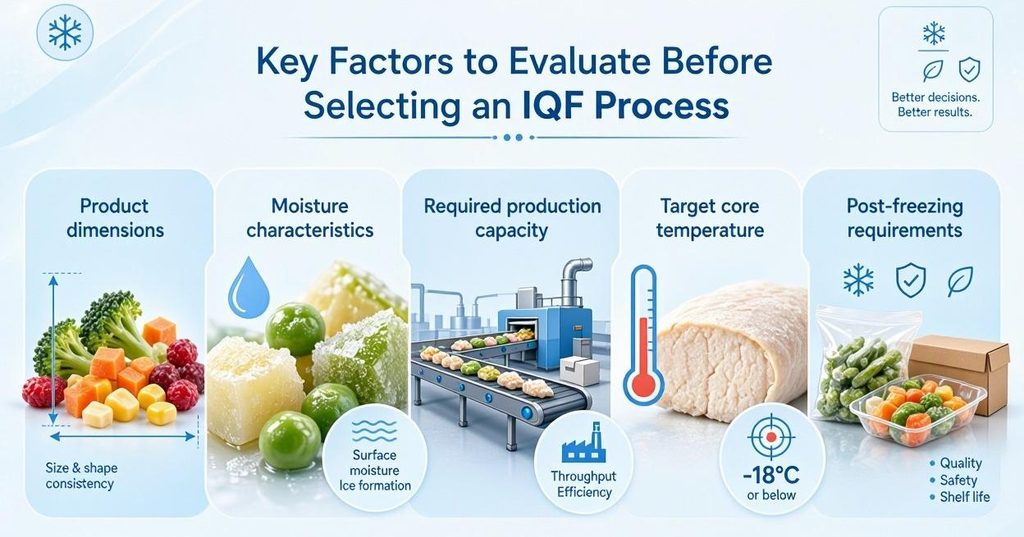
Before introducing IQF technology into a food processing operation, several parameters should be evaluated:
- Product dimensions: Piece size, thickness, and shape determine heat-transfer distance and freezing time.
- Initial product temperature: Higher incoming temperatures generally increase the amount of heat that must be removed.
- Moisture characteristics: Total moisture, surface water, and soluble solids all influence freezing behavior.
- Product mechanical strength: Delicate fruits and seafood require appropriate control of material handling and airflow.
- Required production capacity: Processing throughput must be matched with conveyor loading density and freezing residence time.
- Target core temperature: The required final temperature should be established according to product specifications and applicable food safety requirements.
- Post-freezing requirements: Individual separation, glazing, packaging, and frozen storage conditions also influence final product quality.
A reliable IQF process is therefore not determined by freezer temperature alone. It depends on the interaction between food properties, heat-transfer conditions, mechanical handling, and operating parameters.
Conclusion
IQF technology has broad applications in fruit and vegetable processing, seafood production, and meat and poultry manufacturing. However, the suitability of the technology varies considerably depending on the physical and compositional characteristics of individual products.
Surface moisture and product contact are particularly important factors in preventing adhesion, while total moisture content, soluble solids, and internal structure influence the overall freezing load and final product quality.
Fluidized-bed freezing systems are particularly suitable for small products that can be separated through controlled airflow, whereas mesh-belt and spiral freezing systems can accommodate a wider range of product sizes and geometries.
Ultimately, selecting an appropriate IQF process requires a product-specific assessment. Understanding the relationship between food composition, physical structure, and freezing conditions provides a more reliable basis for equipment selection, process optimization, and consistent frozen product quality.
References and Further Reading
1. FAO – Freezing of Fruits and Vegetables
An overview of fruit and vegetable freezing methods, fluidized-bed freezing equipment, and their applications in food processing.
2. ASHRAE Handbook – Industrial Food-Freezing Systems
Engineering guidance on industrial food-freezing equipment, heat transfer, product quality, and freezing-related dehydration.
International guidance covering quick-frozen food processing, product characteristics, freezing procedures, and temperature control.
4. NOAA – Fluidized Bed Freezers
Technical information on fluidization principles and their application in freezing small food particles and seafood products.
5. Introduction to Food Engineering – Food Freezing
An engineering reference covering food freezing mechanisms, air-blast freezing, and fluidized-bed IQF technology.