
Quick freezing is an important technology in the food industry for extending product shelf life while maintaining food quality. However, food freezing involves more than simply converting water from a liquid into a solid state. It also causes moisture redistribution, changes in cellular structure, and alterations in the physical properties of food tissues. These changes directly affect the texture, appearance, moisture content, and sensory quality of food after thawing.
Among these factors, ice crystal formation and growth play a critical role in determining the quality of frozen foods. The size, location, and distribution of ice crystals during freezing can affect the integrity of food cell structures and, consequently, the ability of the product to retain moisture after thawing.
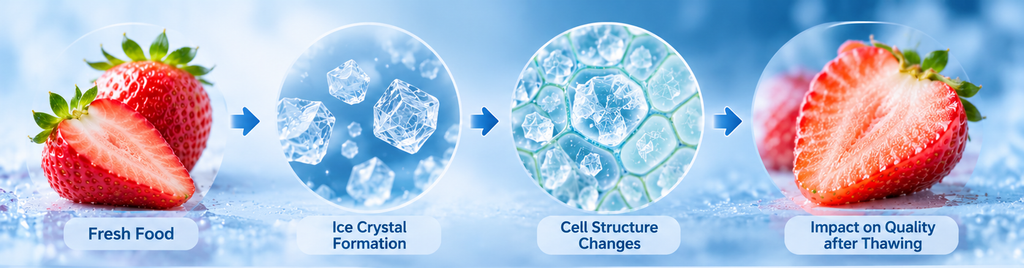
Understanding the mechanisms of ice crystal formation helps explain why different freezing rates produce different food quality outcomes. It also provides a scientific basis for selecting and optimizing industrial freezing processes.
1. How Does Ice Crystal Size Affect Food Cell Structure?
When the temperature of food falls below its initial freezing point, water inside the product begins to form ice crystals. Ice crystals first develop at nucleation sites and gradually grow as more water freezes.
Their size and distribution are influenced by several factors, including freezing rate, food composition, initial product temperature, and heat transfer conditions.
During relatively slow freezing, fewer ice crystals may form initially. Individual crystals have more time to grow, making larger crystals more likely to develop. These crystals generally grow in the extracellular spaces and can exert mechanical pressure on surrounding cell membranes and tissue structures.
In contrast, rapid freezing generally promotes the formation of a greater number of ice crystals within a shorter period. This tends to produce smaller crystals and may reduce localized mechanical damage to food tissues.
These differences are particularly noticeable in foods with delicate cellular structures:
- Fruits: Larger ice crystals may damage cell walls and membranes, causing the flesh to soften and making it difficult for the fruit to retain its original shape after thawing.
- Vegetables: Damage to cell membranes and tissue structures may reduce crispness and affect the appearance of thawed products.
- Meat and seafood: Changes in muscle fiber structure and protein functionality may reduce water-holding capacity, affecting texture and eating quality.
It is important to note that smaller ice crystals do not automatically guarantee better food quality. The location and uniformity of ice crystal distribution, as well as crystal stability during frozen storage, also influence the final product characteristics.
2. Moisture Migration and Changes in Food Microstructure
Ice crystal formation is closely associated with moisture migration within food.
During freezing, water preferentially enters the ice phase, while salts, sugars, and other dissolved substances become increasingly concentrated in the remaining unfrozen liquid phase.
The resulting differences in water concentration and chemical potential drive moisture redistribution within food tissues.
In foods with cellular structures, some intracellular water may migrate into extracellular spaces, where it can form new ice crystals or contribute to the growth of existing ones.
This process may lead to several structural changes:
- Cell dehydration: A reduction in intracellular water causes cells to shrink and may compromise their structural integrity.
- Cell membrane damage: Mechanical forces generated by growing ice crystals, together with changes in local solute concentrations, may disrupt cell membrane structures.
- Tissue deformation: Changes in moisture distribution and ice crystal volume can alter the original arrangement of cells within the tissue.
- Reduced water-holding capacity: Once tissue structures are damaged, food may become less capable of retaining moisture during thawing.
These changes are particularly relevant to high-moisture foods such as strawberries, mangoes, leafy vegetables, and fish.
Furthermore, structural changes caused by ice crystals do not necessarily stop once freezing is complete. During frozen storage, repeated temperature fluctuations may cause ice recrystallization. In this process, some smaller ice crystals gradually disappear while larger crystals continue to grow.
This can cause further damage to food tissue structures. As a result, product quality may deteriorate over time even when the food remains frozen.
3. How Does Freezing Rate Affect Food Texture?
Freezing rate is one of the key parameters influencing ice crystal formation. It generally describes how quickly the product temperature decreases as it passes through the main ice crystal formation temperature range.
Different freezing rates produce different ice crystal microstructures, which can subsequently affect the sensory quality of food after thawing.
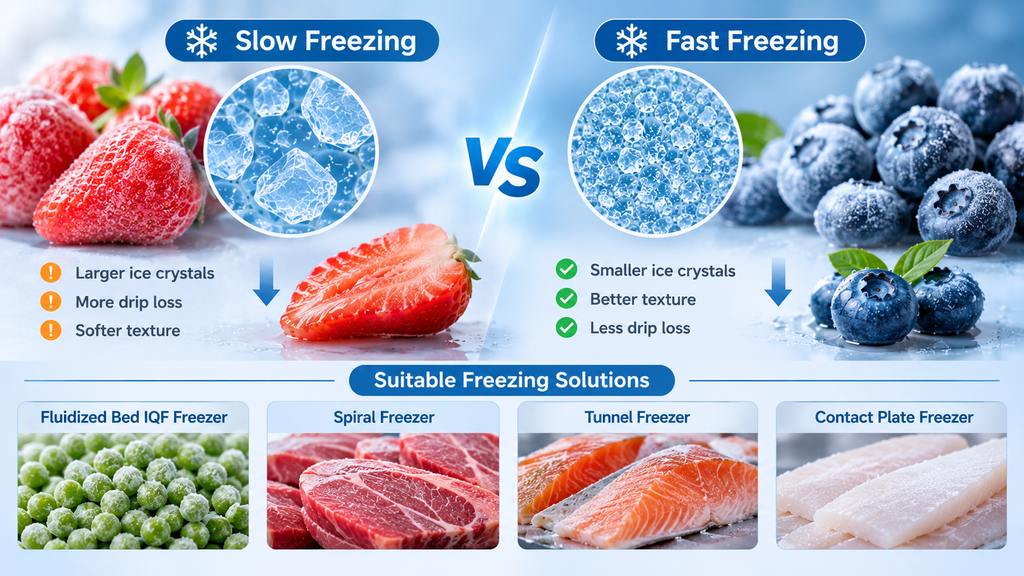
Slow Freezing
- Generally produces fewer, larger ice crystals.
- Allows more time for extracellular ice crystal growth and moisture migration.
- May cause more noticeable damage to cellular structures.
- Can result in softer textures and greater drip loss after thawing.
Rapid Freezing
- Generally produces a larger number of smaller ice crystals.
- May reduce localized mechanical damage to food tissues.
- Is generally more favorable for preserving the original tissue structure.
- Under suitable process conditions, can help improve texture retention and reduce moisture loss after thawing.
Research on meat products has also demonstrated the influence of freezing rate on thawing loss. For example, a beef study published in Food Chemistry in 2022 reported a thawing loss of 4.35% in the ultra-rapid freezing group, compared with 8.22% in the slow-freezing group under the specific experimental conditions. The study involved 48-hour freezing and storage conditions.
However, freezing rate should not be evaluated independently of food type and tissue structure.
For strawberries, blueberries, and diced vegetables, where maintaining individual product shape is important, rapid freezing is often particularly valuable. A common equipment choice for these products is the fluidized bed IQF freezer. By using high-velocity, low-temperature airflow to suspend and separate small food particles, this system enhances surface heat transfer. It can help shorten freezing time and improve freezing uniformity between individual particles.
Both Yurnfreeze and OctoFrost offer IQF fluidized bed freezing equipment. Yurnfreeze uses an optimized airflow channel design to improve airflow distribution and product fluidization, supporting more consistent freezing conditions.
Meat, fish, and prepared foods require a different approach. The appropriate freezing process depends on product thickness, internal structure, freezing time, and airflow conditions.
For example:
- Spiral freezers are widely used for continuous freezing of meat, poultry, and prepared foods. The JBT Marel Frigoscandia GYRoCOMPACT series is a representative example.
- Tunnel freezers can be used for fish, meat, and various prepared foods. GEA and DSI Dantech both offer relevant freezing systems.
- Contact plate freezers are commonly used for fish fillets, minced fish products, and block-shaped foods.
The most suitable system depends on the product characteristics, required throughput, and target freezing conditions.
4. What Is Drip Loss, and Why Does It Matter?
Drip loss refers to the liquid released by frozen food during thawing. It is commonly used as an indicator of changes in food tissue structure and water-holding capacity.
When ice crystals melt, the previously frozen water returns to a liquid state. If cell membranes and tissue structures remain relatively intact, some of this water can be retained within the food.
However, if significant cellular damage has occurred during freezing, the tissue may be less capable of retaining the melted water. Some of the liquid can then escape through intercellular spaces and gaps between muscle fibers.
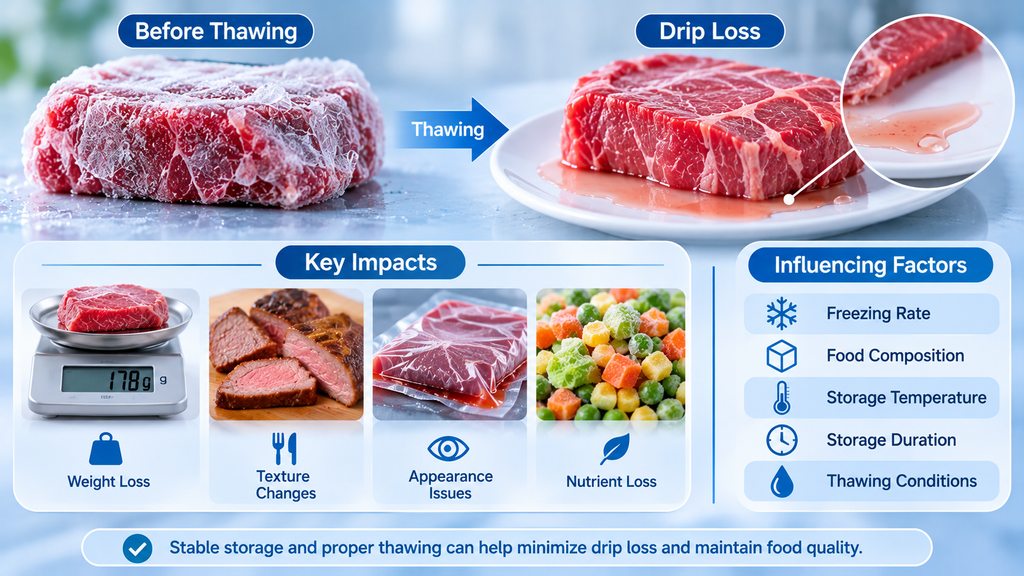
Drip loss mainly affects the following aspects of food quality:
- Product weight: Liquid loss reduces the actual weight of the thawed product and its saleable weight.
- Texture and mouthfeel: Meat and seafood may become drier and less juicy, while fruits and vegetables may soften or develop a watery texture.
- Appearance: Liquid accumulated inside packaging can negatively affect the visual quality of the product.
- Nutritional composition: Some water-soluble nutrients and other dissolved components may be lost along with the thawing liquid.
Drip loss is influenced by several factors:
| Influencing Factor | Potential Impact on Drip Loss |
|---|---|
| Freezing rate | Influences ice crystal size and distribution |
| Food composition | Determines moisture distribution and tissue characteristics |
| Storage temperature | Temperature fluctuations may accelerate ice recrystallization |
| Storage duration | Long-term storage may intensify structural changes |
| Thawing conditions | Affect the rate of moisture release and the tissue’s ability to retain water |
Therefore, reducing drip loss is not simply a matter of increasing freezing speed. Stable frozen storage conditions and appropriate thawing methods are equally important.
5. How Do Different Freezing Methods Affect Ice Crystal Formation?
Different industrial freezing methods use different heat transfer mechanisms. These differences influence the freezing rate, temperature distribution, and resulting ice crystal structure.
| Freezing Method | Heat Transfer Principle | Influence on Ice Crystal Formation | Typical Applications |
|---|---|---|---|
| Air Blast Freezing | Fans circulate low-temperature air over the food surface, removing heat through convection. | At sufficiently high freezing rates, it can promote the formation of more numerous, smaller ice crystals. Large products may develop uneven ice crystal distributions due to temperature differences between the surface and core. | Peas, corn, berries, meat, poultry, and prepared foods |
| Contact Freezing | Food is placed in direct contact with low-temperature metal plates, allowing heat to be removed through conduction. | Good surface contact can shorten freezing time and limit excessive ice crystal growth. Poor contact or slow internal heat transfer may result in larger crystals and uneven distribution. | Fish, minced fish products, meat, block-shaped foods, and packaged products |
| Impingement Freezing | High-velocity air jets are directed onto the food surface from one or more directions to enhance convective heat transfer. | Thin products can pass through the maximum ice crystal formation zone relatively quickly, favoring the formation of smaller crystals. However, differences in internal cooling rates may still result in variations in crystal size. | Thin meat slices, fish fillets, burger patties, and flat prepared foods |
Note: Ice crystal size is influenced not only by the freezing method but also by food composition, tissue structure, product thickness, initial temperature, and the actual freezing curve. The descriptions above represent general trends under typical operating conditions and do not imply identical results across all products and equipment.
6. How Can Ice Crystal Formation Be Controlled in Industrial Freezing?
In industrial food processing, controlling ice crystal formation requires a comprehensive understanding of product characteristics, heat transfer conditions, and the overall freezing process. It cannot be achieved by relying on a single equipment parameter.
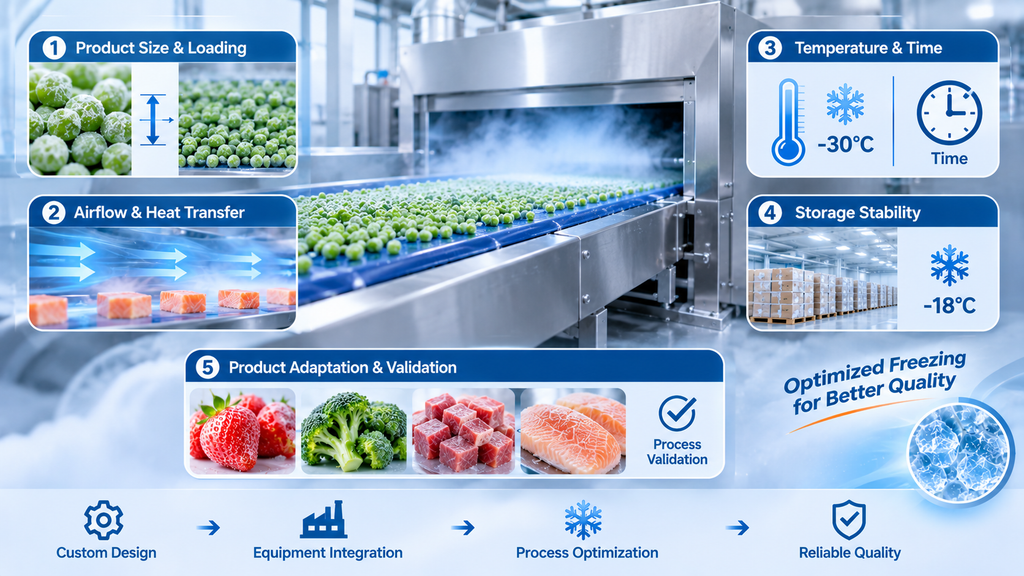
The following factors deserve particular attention:
1. Product Dimensions and Loading Density
Product thickness, individual particle size, and loading density all affect the distance and resistance through which heat must travel.
Excessively dense loading may restrict airflow and lead to uneven freezing. Appropriate product spacing and loading conditions help maintain consistent heat transfer throughout the freezing process.
2. Airflow Distribution and Heat Transfer Uniformity
For air-based freezing systems, airflow velocity and distribution directly affect heat transfer at the product surface.
Uneven airflow can result in different freezing times for products located in different areas of the freezer. Proper airflow management is therefore important for maintaining consistent freezing conditions.
3. Freezing Temperature and Residence Time
Operating temperatures should be evaluated in relation to product thickness, initial temperature, and the required final core temperature.
Simply lowering the air temperature does not necessarily guarantee uniform freezing throughout the product. Residence time and internal heat transfer must also be considered.
4. Frozen Storage Stability
Maintaining stable storage temperatures helps minimize ice recrystallization.
Repeated temperature fluctuations may cause ice crystals to gradually increase in size, resulting in further damage to food tissue structures. Temperature stability throughout the cold chain is therefore essential for maintaining frozen food quality.
5. Product Adaptation and Process Validation
Different foods have different moisture contents, tissue structures, thermal properties, and quality requirements. Freezing processes should therefore be validated through actual product testing rather than relying solely on the equipment’s rated capacity or theoretical operating parameters.
When replacing equipment or upgrading an existing production line, additional engineering factors must also be considered. These include existing installation dimensions, refrigeration capacity, airflow configuration, conveying structures, and control parameters. Such factors determine whether new equipment can achieve the intended freezing conditions within the existing production environment.
In relevant engineering projects, Yurnfreeze provides customized equipment design and engineering adaptation based on actual factory conditions. These services cover equipment configuration for new production lines, replacement of existing equipment, and upgrades to refrigeration systems or freezing processes to accommodate different plant layouts and processing requirements.
Conclusion
Ice crystal formation is an important physical mechanism connecting food freezing conditions with final product quality. The size, distribution, and location of ice crystals influence cellular damage, moisture migration, and structural changes that occur during freezing and thawing.
Rapid freezing generally favors the formation of smaller ice crystals and may help reduce tissue damage. However, final product quality is also affected by food composition, product dimensions, storage stability, and thawing conditions.
For industrial food processors, the objective of a freezing process should not simply be to achieve the lowest possible freezing temperature or the shortest freezing time. Instead, the goal is to establish a stable and repeatable process that achieves an appropriate balance between heat transfer performance, product characteristics, energy consumption, and final product quality.
A deeper understanding of ice crystal formation provides a more scientific basis for selecting industrial freezing equipment and optimizing freezing processes.
FAQ
Q1. Why Can Frozen Food Deteriorate During Storage Even If It Never Thaws?
Freezing does not completely stop physical changes inside food. During long-term storage, temperature fluctuations may cause some smaller ice crystals to partially melt. The released water can migrate and refreeze on the surfaces of larger crystals. This process is known as ice recrystallization.
As recrystallization continues, the average ice crystal size may increase, causing further damage to cell membranes and tissue structures. After thawing, the food may exhibit greater drip loss, softer texture, and reduced eating quality.
Therefore, frozen food quality depends not only on the initial freezing process but also on storage temperature stability, storage duration, and the magnitude of temperature fluctuations.
Q2. Is IQF Freezing Always Better Than Conventional Tunnel Freezing for Maintaining Food Quality?
Not necessarily. IQF (Individual Quick Freezing) focuses on keeping individual food pieces relatively separate during freezing, minimizing adhesion between particles. It is particularly suitable for products such as peas, blueberries, diced fruits and vegetables, and small seafood.
However, food quality also depends on the actual freezing rate, product dimensions, airflow distribution, and storage conditions. A conventional tunnel freezer can also achieve good freezing results when properly designed with suitable airflow and conveying arrangements.
Equipment selection should be based on product characteristics, required throughput, and final quality requirements rather than the equipment designation alone.
Q3. Why Do Different Foods Have Significantly Different Freezing Times in the Same Freezer?
Different foods vary in moisture content, initial temperature, density, thermal conductivity, and tissue structure. These properties affect how quickly heat can move from the interior of the product to its surface.
Product thickness and loading density are also important. For example, a whole piece of meat and diced meat may have the same total weight, but their different heat transfer distances can result in significantly different times to reach the target core temperature.
Therefore, equipment capacity should not be compared without considering the specific food product and processing conditions.