
Freezing is fundamentally a heat transfer process. It involves continuously removing heat from food through a refrigeration system until the product reaches the target freezing temperature. However, different freezing technologies rely on different heat transfer mechanisms, which directly influence freezing rates, temperature uniformity, energy consumption, and final product quality.
In industrial food processing, air blast freezing, contact freezing, and fluidized bed freezing are three representative freezing methods. Their main differences lie in the heat transfer medium, the contact conditions between food and cooling surfaces, and the way cold air moves around the product.
Understanding the physical principles behind these technologies helps explain the performance differences between freezing systems and provides a technical basis for selecting appropriate freezing methods in industrial applications.
1. Air Blast Freezing: Forced Convection Heat Transfer
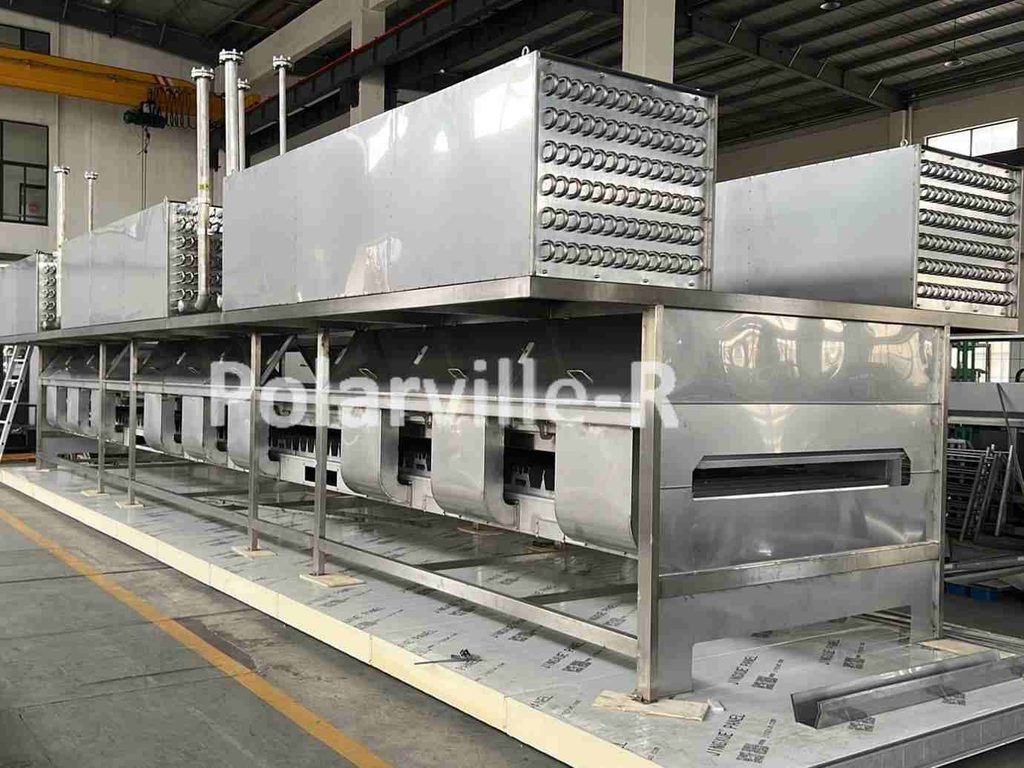
Air blast freezing primarily relies on forced convection to transfer heat. The refrigeration system cools the air, while fans circulate low-temperature air across the food surface, removing heat from the product.
The heat transfer process generally involves three stages:
- Heat inside the food moves toward the product surface through thermal conduction.
- Heat at the food surface transfers to the surrounding cold air through convection.
- The refrigeration system continuously absorbs heat from the circulating air through the evaporator, maintaining the required freezing conditions.
The convective heat transfer rate can be expressed using the following equation:
\[ Q=hA(T_s-T_a) \]
Where:
- \(Q\): Heat transfer rate (W)
- \(h\): Convective heat transfer coefficient (W/m²·K)
- \(A\): Effective heat transfer area between the food and air (m²)
- \(T_s\): Food surface temperature (°C)
- \(T_a\): Surrounding air temperature (°C)
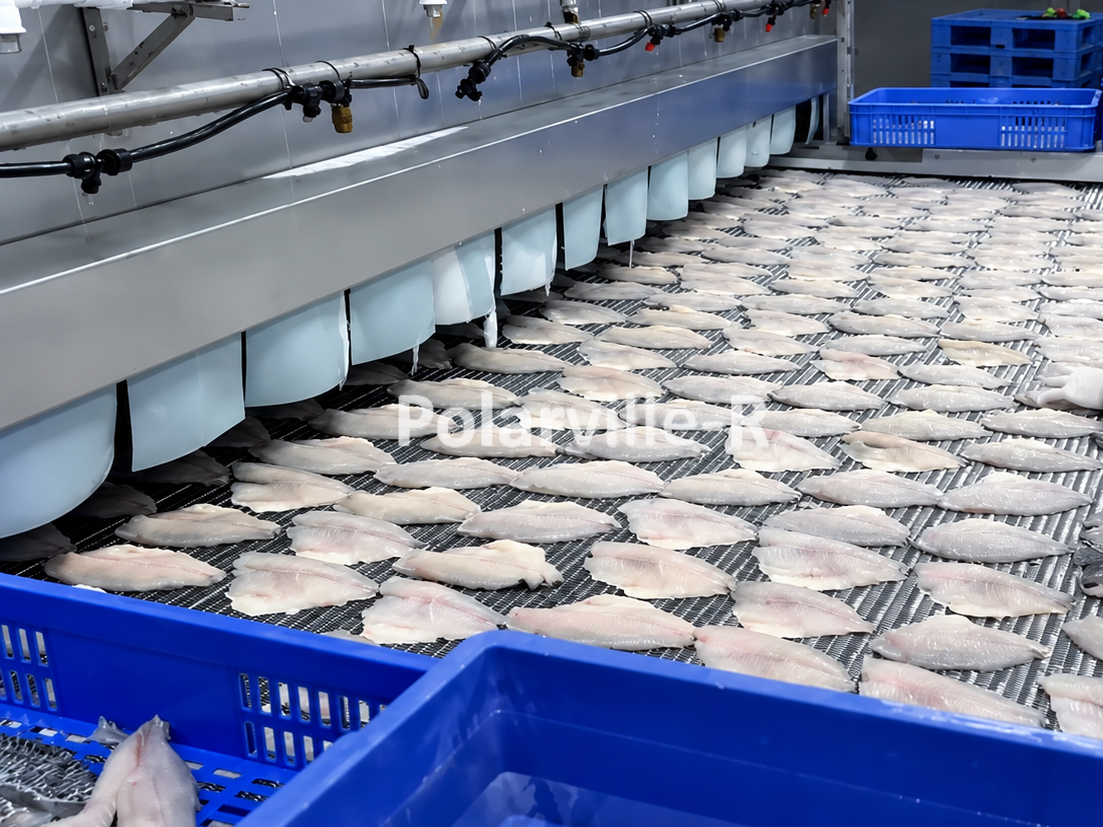
Increasing air velocity generally enhances the convective heat transfer coefficient. However, the relationship is not simply linear. The actual effect also depends on food geometry, airflow distribution, and operating conditions.
One of the main challenges in air blast freezing is achieving uniform airflow. If air velocities vary significantly across different areas of the freezing chamber, some products may experience longer freezing times, resulting in uneven product temperatures.
Spiral freezers and tunnel freezers commonly use this heat transfer mechanism. These systems are suitable for a wide range of food products with different shapes, dimensions, and processing requirements.
2. Contact Freezing: Direct Conductive Heat Transfer
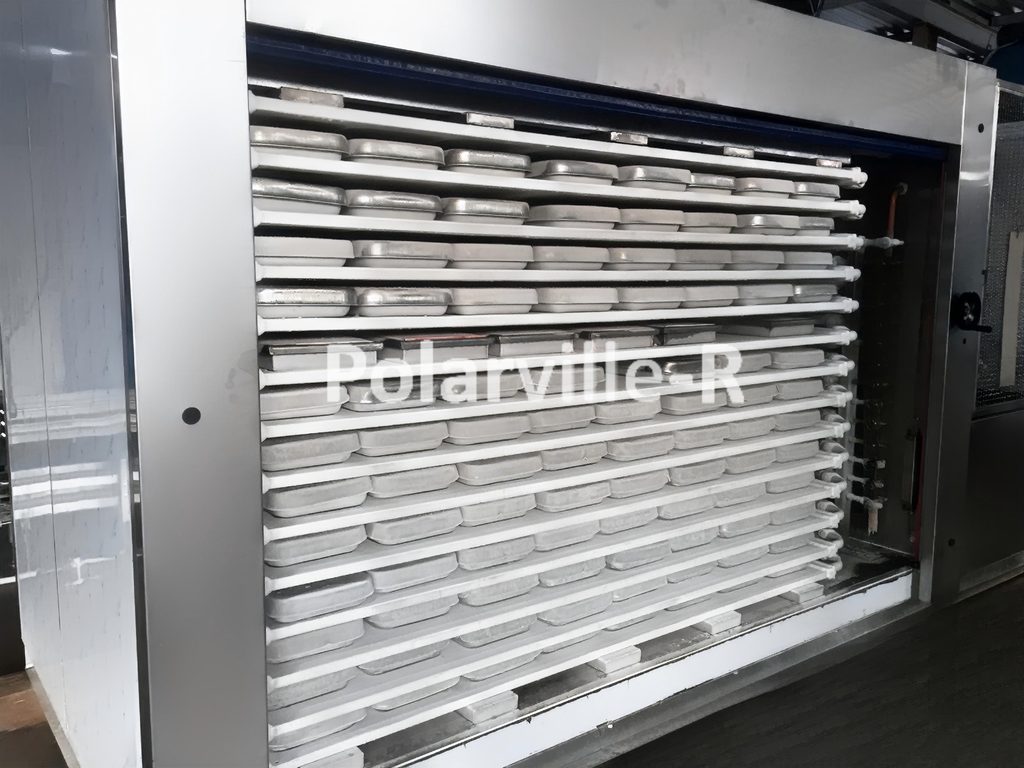
Contact freezing primarily transfers heat through direct contact between food products and low-temperature metal surfaces. Common cooling surfaces include refrigerated plates and chilled metal belts.
Unlike air blast freezing, which depends on air circulation, contact freezing relies mainly on thermal conduction to remove heat from the product.
The heat transfer process can be simplified using Fourier’s law:
\[ Q=\frac{kA(T_p-T_c)}{L} \]
Where:
- \(k\): Thermal conductivity of the material (W/m·K)
- \(A\): Effective heat transfer area (m²)
- \(T_p\): Food temperature (°C)
- \(T_c\): Cooling surface temperature (°C)
- \(L\): Effective heat transfer thickness (m)
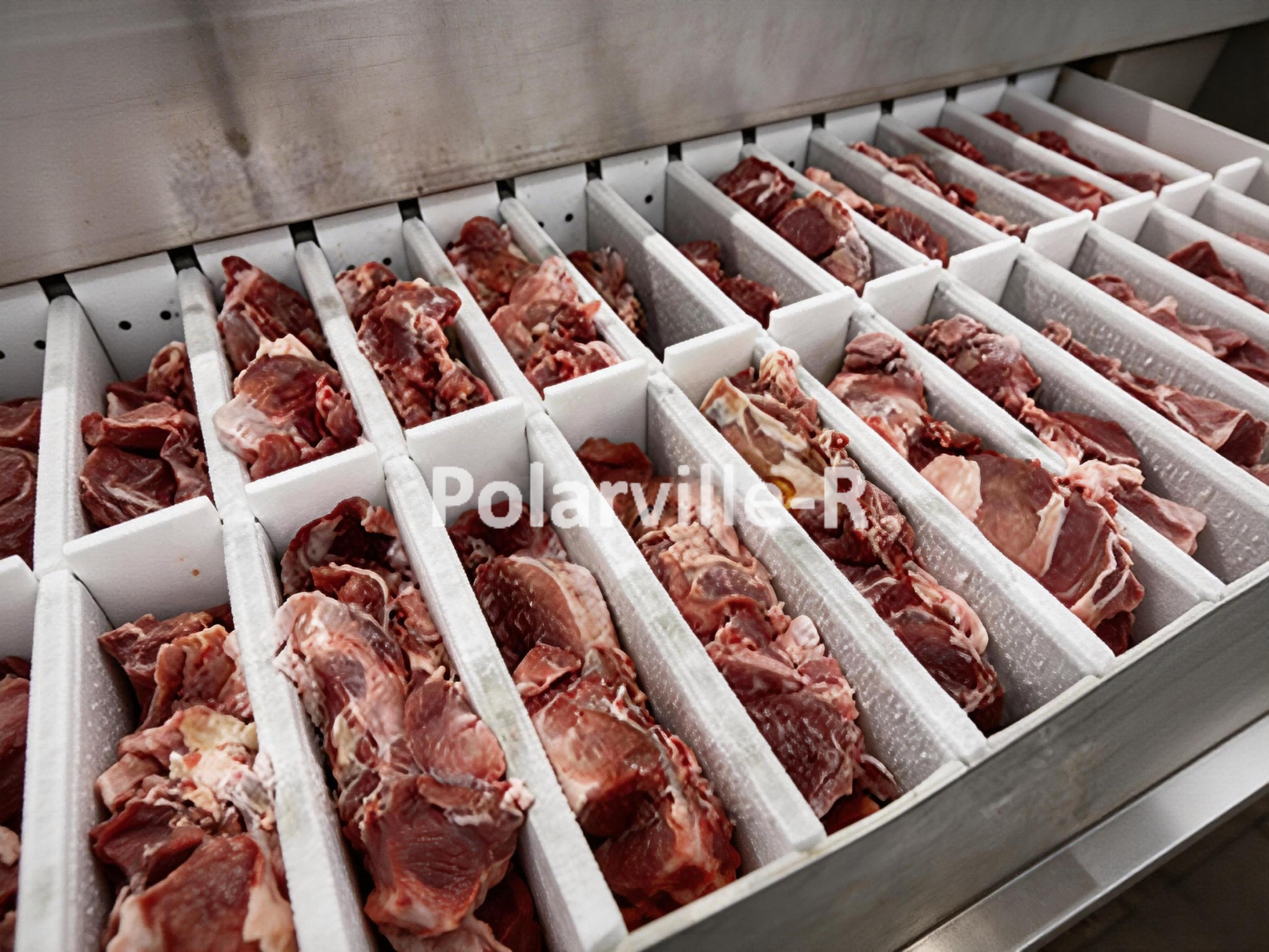
In practical applications, thermal contact resistance between the food and cooling surface also affects heat transfer performance.
For example, uneven food surfaces, air gaps, or inconsistent contact pressure can reduce the actual heat transfer rate.
Plate freezers are typical examples of contact freezing equipment. Food products are placed between refrigerated plates, allowing heat to transfer directly from the food to the metal cooling surfaces.
This method is particularly suitable for products with regular shapes, relatively uniform thicknesses, or stable packaging structures.
Its main physical advantage is the direct heat transfer path. However, actual performance depends heavily on product geometry and the quality of contact between the food and cooling surfaces.
3. Fluidized Bed Freezing: Particle Suspension and Enhanced Convection
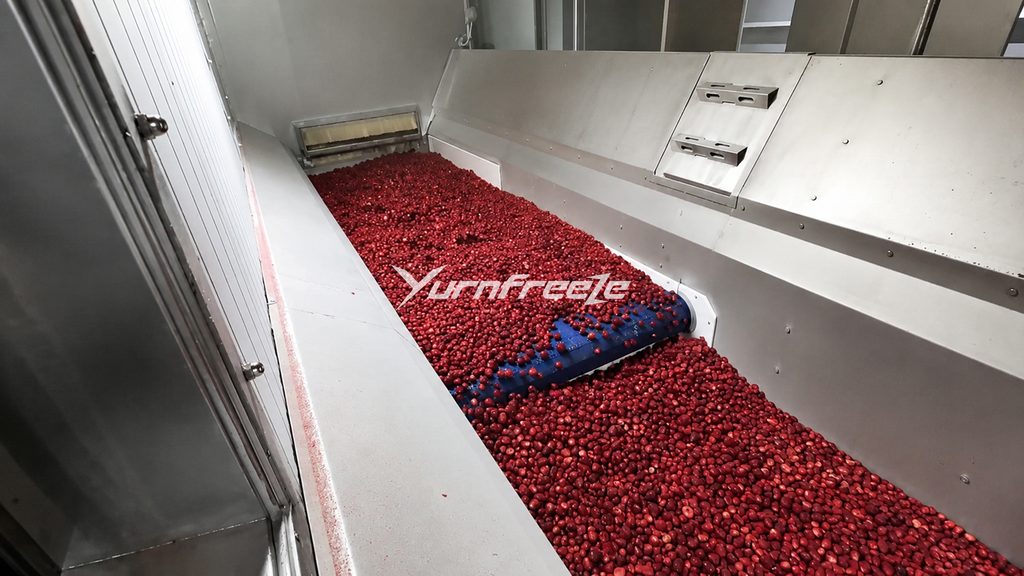
Fluidized bed freezing is primarily used for particulate food products. It works by directing high-velocity cold air upward through a product bed, causing individual food particles to become suspended or partially suspended in the airflow.
When cold air passes upward through a conveyor belt or air distribution plate with uniformly distributed openings, it exerts drag forces on the food particles.
As air velocity increases, the upward aerodynamic force approaches or exceeds the effective weight of the particles. Under suitable conditions, the particle bed enters a fluidized state.
The basic force balance can be simplified as:
\[ F_D\approx mg-F_B \]
Where:
- \(F_D\): Drag force exerted by the air on the particles
- \(m\): Particle mass
- \(g\): Gravitational acceleration
- \(F_B\): Buoyant force
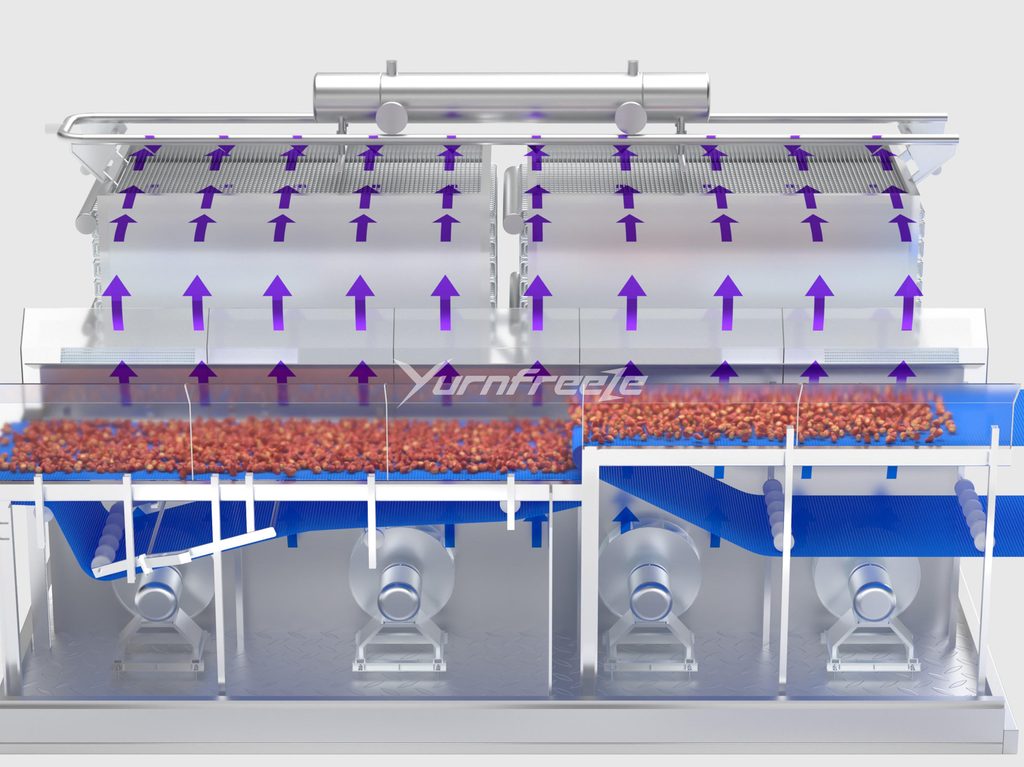
When the upward aerodynamic force is sufficient to support the particles, the bed can enter a fluidized state.
From an engineering perspective, the minimum fluidization velocity is the critical airflow velocity at which fluidization begins. At this point, the pressure drop across the particle bed approximately balances the effective weight of the particles per unit cross-sectional area.
Once fluidization occurs, particles continuously move within the airflow. Prolonged contact between individual particles is reduced, allowing a greater proportion of their surfaces to be exposed directly to cold air.
This process provides several important heat transfer characteristics:
- Increases effective contact between cold air and food surfaces.
- Improves airflow distribution around individual particles.
- Reduces large-scale adhesion caused by prolonged contact between particles.
- Enhances convective heat transfer across the surfaces of small food products.
Fluidized bed freezing is commonly used for peas, sweet corn kernels, berries, diced vegetables, and other small food products that can be individually dispersed.
However, fluidization performance does not depend on air velocity alone. Particle size, density, moisture content, and bed depth also influence the process.
Insufficient airflow may prevent particles from becoming adequately suspended, while excessive airflow can cause product displacement, mechanical damage, or additional fan energy consumption.
4. Comparison of the Heat Transfer Mechanisms
The three freezing methods differ significantly in their primary heat transfer mechanisms and the factors that influence their performance.
| Comparison Factor | Air Blast Freezing | Contact Freezing | Fluidized Bed Freezing |
|---|---|---|---|
| Primary heat transfer mechanism | Forced convection | Thermal conduction | Enhanced forced convection |
| Cooling medium | Low-temperature air | Low-temperature metal surfaces | High-velocity cold air |
| Product movement | Stationary or continuously conveyed | Stationary or continuously conveyed | Suspended or partially suspended |
| Main heat transfer area | Exposed food surfaces | Contact area between food and cooling surfaces | Exposed surfaces of individual particles |
| Key influencing factors | Air velocity and airflow distribution | Contact resistance and product thickness | Fluidization velocity and particle properties |
| Typical applications | Meat, poultry, seafood, bakery products | Solid blocks, flat products, packaged food | Peas, corn, berries, particulate vegetables |
A Simplified Analysis of Heat Transfer Efficiency
From a thermodynamic perspective, the total thermal resistance model can also be used to analyze the heat transfer performance of different freezing methods.
For a simplified heat transfer system:
\[ Q=\frac{\Delta T}{R_{\text{total}}} \]
Where:
- \(\Delta T\): Temperature difference between the food and cooling medium
- \(R_{\text{total}}\): Total thermal resistance along the heat transfer path
For air blast freezing, the total thermal resistance mainly consists of the internal conductive resistance of the food and the air-side convective resistance at the product surface.
For contact freezing, the main resistance components include internal conduction resistance within the food, thermal contact resistance, and heat transfer resistance associated with the refrigerated plates.
For fluidized bed freezing, the total resistance mainly includes internal conductive resistance within the food and convective resistance created by the airflow surrounding individual particles.
Under the same temperature difference, a lower total thermal resistance generally results in a higher heat transfer rate.
It is important to note that this model is primarily intended to explain the underlying heat transfer mechanisms. It does not establish a fixed efficiency ranking among the three freezing methods under all operating conditions.
Actual freezing performance is also influenced by food dimensions, initial temperature, moisture content, loading density, airflow conditions, and refrigerant temperature.
5. How to Select a Freezing Method Based on Food Characteristics
The selection of a freezing method should be based on the physical properties of the food and the actual processing requirements, rather than simply comparing the lowest freezing temperatures that different machines can achieve.
For example:
Air Blast Freezing: Suitable for products with varying shapes and dimensions, relatively large products, or applications requiring continuous processing and conveying.
Contact Freezing: Suitable for products with relatively regular dimensions that can maintain stable contact with refrigerated surfaces.
Fluidized Bed Freezing: Particularly suitable for small particulate products that can be individually dispersed and suspended in an airflow.
In industrial production, different heat transfer methods can also be combined or arranged in separate processing zones according to the freezing stages and process requirements.
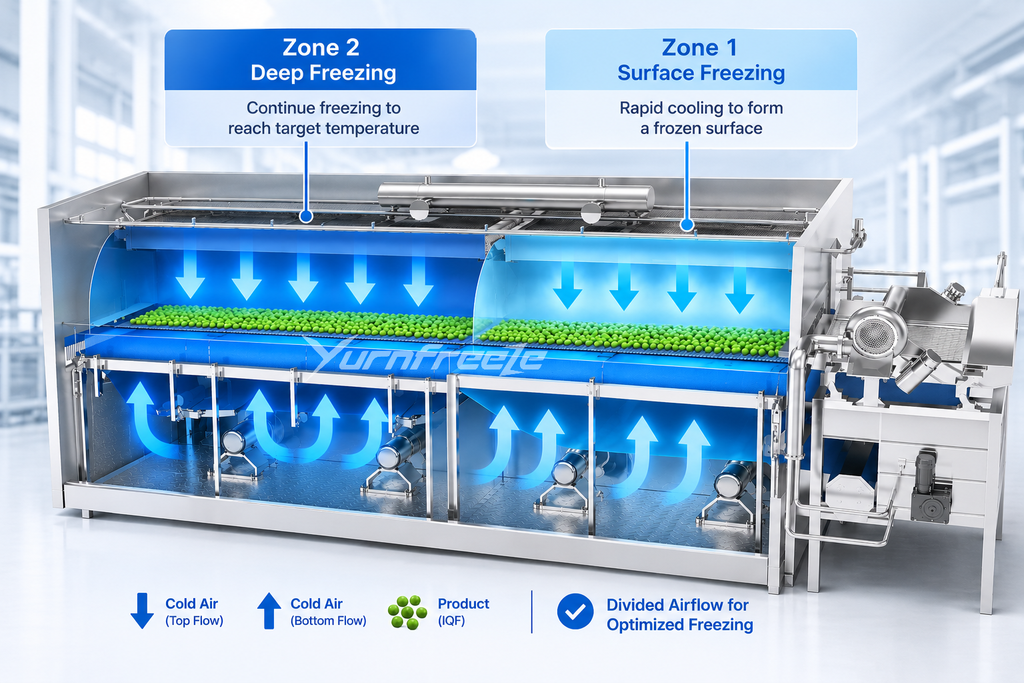
For example, Yurnfreeze fluidized bed IQF systems use zoned airflow arrangements to distinguish between initial surface freezing and subsequent deep-freezing stages. This illustrates how airflow management and staged heat removal can be applied in continuous freezing processes.
Yurnfreeze plate freezers, on the other hand, use low-temperature contact surfaces and are designed for products that require conductive heat transfer during freezing.
These examples demonstrate that the structural design of freezing equipment is closely related to its underlying heat transfer mechanism, rather than being determined solely by refrigeration temperature.
Conclusion
Air blast, contact, and fluidized bed freezing represent three distinct heat transfer approaches in industrial food freezing.
Air blast freezing relies on forced convection, contact freezing primarily uses thermal conduction, while fluidized bed freezing enhances convective heat transfer through particle suspension.
None of these methods is universally superior for all food products. Actual performance depends on food geometry, thermal properties, airflow or contact conditions, and the overall design of the refrigeration system.
Therefore, an appropriate industrial freezing process should be selected by matching the physical characteristics of the food with the relevant heat transfer mechanism and production requirements.
FAQ
Q1. Which is faster: air blast freezing or contact freezing?
Neither method is universally faster. Actual freezing rates depend on product thickness, initial temperature, heat transfer area, and specific operating conditions.
Contact freezing transfers heat directly through refrigerated metal surfaces. When good contact is maintained between the food and cooling plates, and the product thickness is appropriate, relatively high heat transfer rates can be achieved.
Air blast freezing removes heat through the circulation of low-temperature air. It is generally more adaptable to products with complex shapes or those that cannot maintain direct contact with cooling surfaces.
Therefore, freezing rates should be compared using the same product, the same target freezing temperature, and comparable operating conditions rather than relying solely on equipment type.
Q2. Why do different freezing machines have different freezing efficiencies even when they operate at the same temperature?
Freezing efficiency depends not only on the temperature of the cold air or cooling surfaces but also on the actual heat transfer capacity of the system.
For example:
- In air blast freezers, air velocity and airflow distribution influence convective heat transfer.
- In contact freezers, contact area and thermal contact resistance affect conductive heat transfer.
- In fluidized bed freezers, sufficient and uniform airflow is required to maintain an appropriate particle suspension state.
Food thickness, moisture content, initial temperature, and loading density also influence freezing time.
Therefore, the lowest refrigeration temperature alone cannot directly indicate the actual freezing capacity of a machine.
Q3. Is higher air velocity always better in fluidized bed freezing?
No.
Air velocity must be matched to particle size, density, and bed depth. When airflow reaches an appropriate range, individual particles can become sufficiently suspended, improving contact between the cold air and food surfaces.
If air velocity is too low, particles may not fluidize adequately, resulting in localized accumulation and uneven freezing.
If air velocity is too high, particles may collide excessively, become displaced, or suffer mechanical damage. Excessive airflow also increases fan energy consumption.
The key to fluidized bed freezing is therefore not simply increasing air velocity, but determining an appropriate fluidization velocity and achieving uniform airflow distribution.
Q4. Which freezing method is more energy-efficient?
Energy consumption cannot be determined solely by the type of freezing method. The operating conditions of the entire system must be considered.
Contact freezing provides a relatively direct heat transfer path. However, actual energy consumption is also affected by refrigerated plate temperatures, contact conditions, and product throughput.
Air blast freezing requires fans to maintain continuous air circulation. Its energy consumption is influenced by airflow volume, static pressure, and fan efficiency.
Fluidized bed freezing generally requires relatively high airflow velocities. Consequently, fan power consumption and system pressure losses are also important energy considerations.
A meaningful energy comparison should include the combined electricity consumption of the refrigeration system, fans, conveyors, and auxiliary equipment.
Specific energy consumption per unit of product frozen (kWh/t) is one useful performance indicator for evaluating and comparing different industrial freezing systems.