
Understanding Freezing Temperatures, Temperature Gradients, and Product Consistency
Temperature control is one of the key factors influencing the operational performance of industrial food freezing systems. However, achieving a specified freezing temperature does not necessarily mean that every product experiences exactly the same freezing conditions.
In industrial food processing, variations in product dimensions, loading density, airflow distribution, and heat transfer conditions can result in temperature variations within freezing equipment. These variations may subsequently affect freezing time, product quality, moisture retention, and consistency between production batches.
Therefore, understanding the relationship between freezing temperature and temperature uniformity is essential when designing, operating, or upgrading industrial freezing equipment.
1. Understanding the Difference Between −18°C and −35°C
In industrial freezing applications, −18°C and −35°C are two commonly referenced temperatures. However, they generally represent different aspects of the freezing process.

−18°C: A Reference Temperature for Frozen Food
−18°C is widely recognized as an important reference temperature for frozen food storage and cold chain transportation.
According to the Codex Alimentarius Code of Practice for the Processing and Handling of Quick Frozen Foods (CXC 8-1976), quick-frozen foods should be maintained at −18°C or below throughout the cold chain, subject to the applicable tolerances and regulatory requirements.
Regarding the freezing process itself, the Code also specifies that, after thermal stabilization, the thermal centre of the product should reach −18°C or below to satisfy the relevant requirements for completion of quick freezing.
It is important to distinguish between the air temperature surrounding the product and the actual temperature inside the food. Even when a freezing system operates at −18°C, this does not mean that the product’s core has already reached −18°C.
−35°C: A Typical Operating Condition for Industrial Quick Freezing
Industrial air-blast freezers and IQF (Individual Quick Freezing) systems commonly operate at lower air temperatures, typically within a range of approximately −30°C to −40°C, depending on product characteristics and equipment configuration.
When the operating temperature inside the freezer reaches approximately −35°C, a larger temperature difference can be established between the product and the surrounding cooling medium. This increases the potential rate of heat transfer and can shorten freezing time.
For example, the ASHRAE section on Industrial Food-Freezing Systems describes two-stage belt freezing systems operating at approximately −32°C to −40°C in their primary freezing zones.
However, −35°C should not be interpreted as a required core temperature for all food products. It generally refers to the operating air temperature within the freezing environment.
The actual operating temperature should be determined by considering several factors:
- Product type and initial temperature
- Product thickness, dimensions, and shape
- Moisture content and thermophysical properties
- Required freezing time
- Air velocity and airflow distribution
- Refrigeration capacity and equipment operating performance
The objective of industrial quick freezing is not simply to achieve the lowest possible temperature, but to remove heat efficiently and consistently while maintaining the required product quality.
2. Temperature Gradient Issues in Industrial Freezing Systems
A temperature gradient refers to temperature differences between different locations within a freezing system or between individual products within the same production batch.
During industrial freezing operations, temperature gradients mainly occur in three areas.
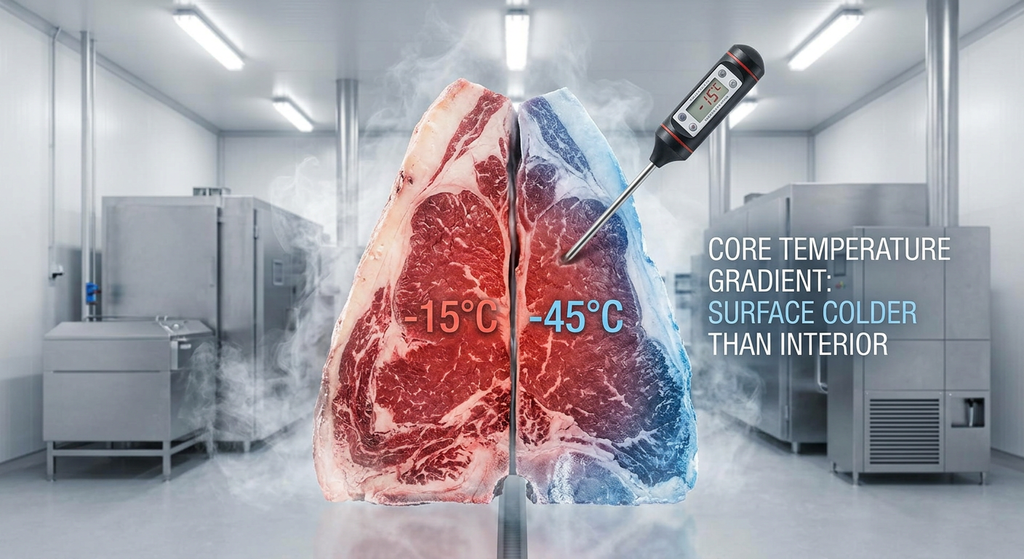
2.1 Temperature Differences Within Individual Products
During freezing, heat is initially transferred from the product surface to the surrounding cooling medium. Heat from the interior subsequently moves toward the surface.
As a result, the outer layers of a product may already be frozen while the internal core remains at a relatively higher temperature.
This temperature difference is particularly noticeable in products with larger dimensions or greater thickness, because the heat transfer distance between the surface and the thermal centre is longer.
When freezing conditions are insufficient, the product core may require considerably more time to reach the target temperature.
2.2 Temperature Differences Across Different Areas of the Freezer
Air temperature and velocity are not necessarily uniform throughout the freezing chamber.
Potential causes of these variations include:
- Uneven airflow distribution
- Differences in evaporator operating performance
- Cold air bypassing products and creating airflow short-circuiting
- Variations in product loading across different conveyor sections
- Insufficient spacing between individual products
- Poorly designed return air passages
For example, products located in areas with stronger airflow may freeze faster than those positioned in lower-velocity regions.
In belt-type freezing systems, uneven product distribution and localized overloading can further restrict airflow, increasing differences in freezing time between different sections of the equipment.
2.3 Temperature Differences Between Production Batches
Even when identical equipment settings are maintained, different production batches do not necessarily achieve exactly the same freezing results.
Factors such as the temperature of incoming raw materials, product dimensions, moisture content, loading density, and processing conditions can all influence the final freezing outcome.
This means that maintaining a constant air temperature inside the freezing chamber alone is insufficient to guarantee consistent temperature conditions across all products.
3. How Temperature Non-Uniformity Affects Product Quality
Temperature variations during freezing can influence several important food quality characteristics.
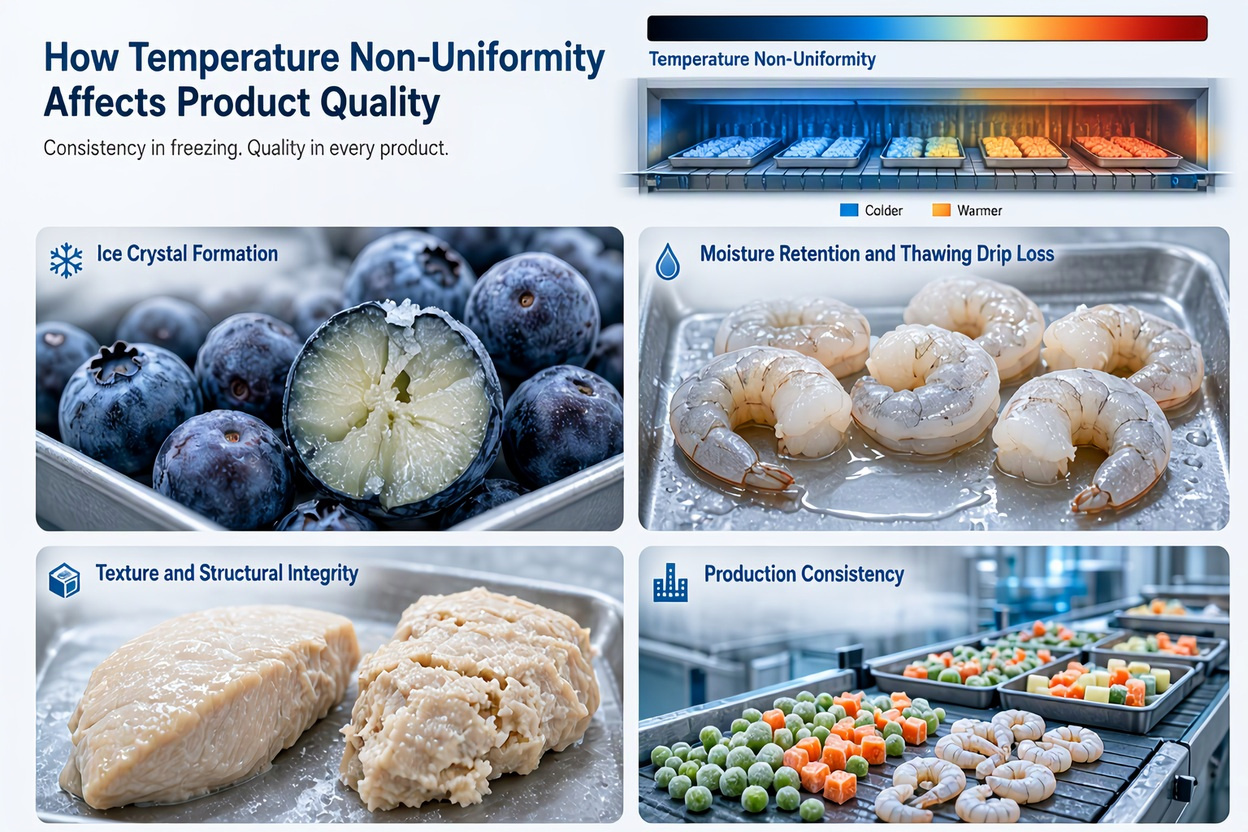
Ice Crystal Formation
The rate at which food passes through the Maximum Ice Crystallization Zone influences the formation of ice crystals.
In general, slower freezing provides more time for larger ice crystals to develop, potentially causing greater damage to the food’s cellular structure.
Moisture Retention and Thawing Drip Loss
Uneven or prolonged freezing conditions may result in differences in moisture retention between individual products.
In addition, prolonged exposure to low-temperature, low-humidity airflow can cause surface dehydration.
Texture and Structural Integrity
Products subjected to different freezing conditions may exhibit variations in firmness, texture, and appearance during thawing or subsequent processing.
Production Consistency
For industrial food processors, inconsistent freezing conditions can lead to quality variations between production batches, increasing the difficulty of downstream processing and quality control.
These issues are particularly relevant for small-sized products with high moisture content or those requiring strict individual freezing quality standards, such as berries, diced vegetables, shrimp, and prepared foods.
4. Key Methods for Improving Temperature Uniformity
Improving temperature uniformity in industrial freezing systems requires coordinated control of equipment design, operating parameters, and production conditions.
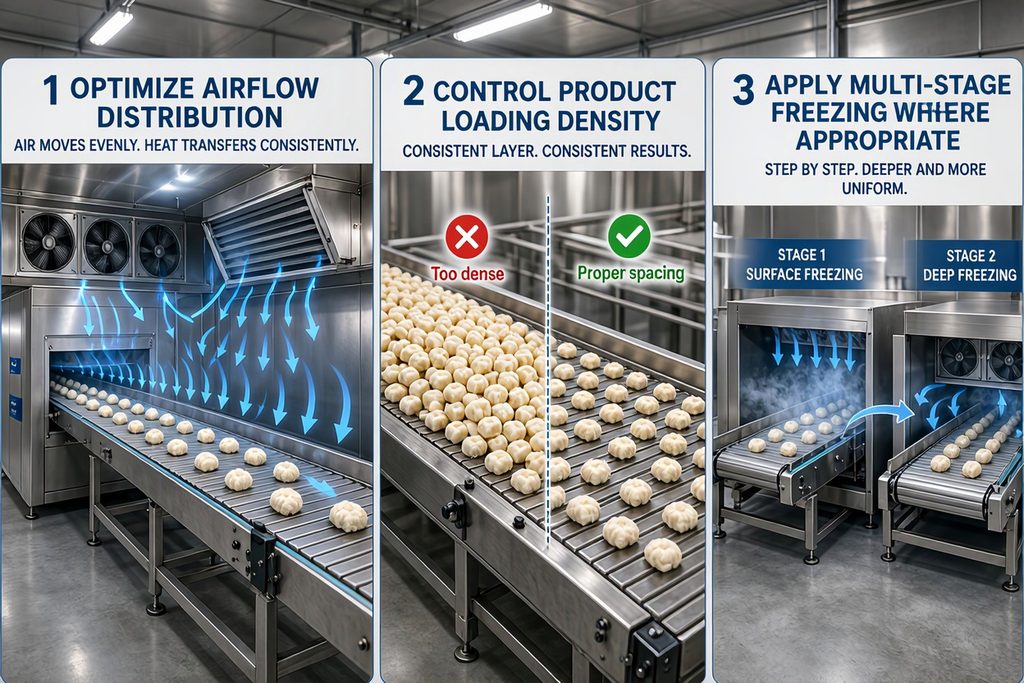
4.1 Optimize Airflow Distribution
In air-blast freezing systems, airflow is one of the primary factors determining heat transfer performance.
Cold air should circulate as evenly as possible around the products rather than preferentially passing through areas with lower airflow resistance.
Key considerations include:
- Whether fan capacity and air velocity are appropriate
- Whether supply and return air passages are properly balanced
- Whether evaporator placement is suitable
- Whether significant airflow short-circuiting occurs
- Whether sufficient spacing is maintained between products
In fluidized bed IQF systems, controlled upward airflow suspends and separates individual food particles. Proper airflow distribution helps improve heat transfer uniformity throughout the product layer.
4.2 Control Product Loading Density
Excessive conveyor loading can restrict airflow and increase the effective resistance to heat transfer between products.
Uneven loading may also cause differences in freezing time across different conveyor sections.
Maintaining a consistent product layer thickness, appropriate spacing between individual products, and a controlled feeding rate can help minimize these variations.
The appropriate loading density should be determined according to product characteristics and the validated processing capacity of the freezing equipment.
4.3 Apply Multi-Stage Freezing Where Appropriate
Certain food products benefit from a staged freezing process.
For example, two-stage belt freezing systems can incorporate an initial surface freezing zone followed by a deep freezing zone.
The first stage primarily establishes an initial frozen layer on the product surface. The second stage continues removing heat from the product interior until the required core temperature is achieved.
Yurnfreeze’s two-stage fluidized bed IQF freezing system provides an example of this approach. The freezing process is divided into two stages: Crust Freezing and Core Freezing.
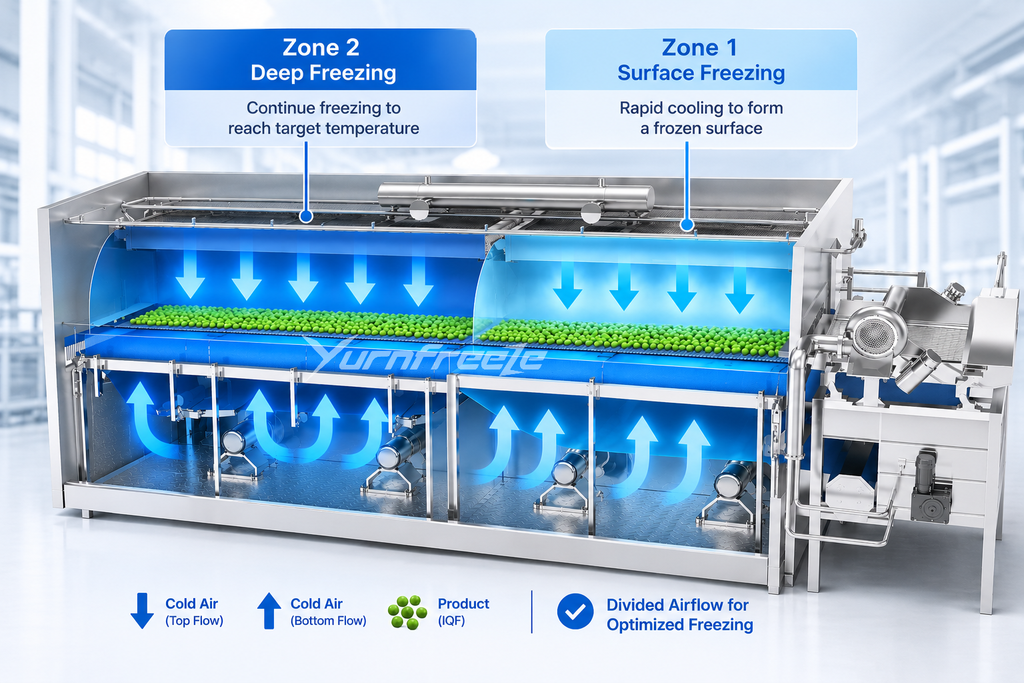
During the first stage, high-velocity cold air rapidly freezes the product surface. A vibrating conveyor structure also helps reduce particle adhesion and clumping.
During the second stage, relatively stable airflow continues removing heat from the product interior, allowing the core temperature to gradually reach the specified freezing requirements.
By applying different airflow control strategies in the two stages, the system is designed to balance individual product separation with internal heat removal.
4.4 Implement Multi-Point Temperature Monitoring
Temperature monitoring should not rely solely on a single sensor installed inside the freezing chamber.
A more comprehensive monitoring approach may include:
- Supply air temperature
- Return air temperature
- Air temperatures at different locations within the freezing chamber
- Product surface temperature
- Product thermal centre temperature
- Product temperature after thermal stabilization
During process validation, representative products should be selected for measurement to identify potential high-temperature and low-temperature areas within the equipment.
The use of data loggers and calibrated temperature sensors helps determine whether the system can maintain consistent freezing performance under normal production conditions.
4.5 Coordinate Refrigeration System Performance and Defrost Control
The refrigeration system must have sufficient capacity to handle the heat load introduced by incoming products, together with other operational heat loads.
Frost accumulation on evaporator coils can gradually restrict airflow and reduce heat transfer performance. If defrost cycles are not properly coordinated with production requirements, temperature fluctuations within the equipment may become more pronounced.
Therefore, regular monitoring of evaporator conditions, refrigeration system performance, fan operation, and defrost programs is necessary.
5. Temperature Uniformity Control Across Different Freezing Technologies
Different industrial freezing systems use different heat transfer mechanisms. Consequently, the key factors influencing temperature uniformity also vary.
| Freezing Technology | Primary Heat Transfer Mechanism | Key Temperature Uniformity Considerations |
|---|---|---|
| Tunnel Freezer | Forced convection | Airflow distribution and product spacing |
| Fluidized Bed IQF Freezer | Controlled upward airflow | Suspension stability and airflow balance |
| Spiral Freezer | Forced convection around spiral conveyor belts | Airflow distribution between conveyor tiers |
| Plate Freezer | Direct contact heat transfer | Contact pressure and product thickness |
| Impingement Freezer | High-velocity impinging air jets | Jet airflow distribution and product exposure |
For example, fluidized bed IQF systems require sufficient and relatively balanced upward airflow to maintain the suspension of individual product particles.
Spiral freezers, on the other hand, require careful control of airflow distribution between multiple conveyor tiers to prevent significant differences in freezing conditions across different areas.
The selection of an appropriate freezing technology should be based on a comprehensive assessment of product characteristics, processing capacity, available installation space, and process requirements.
6. Practical Approaches to Achieving Consistent Freezing Results
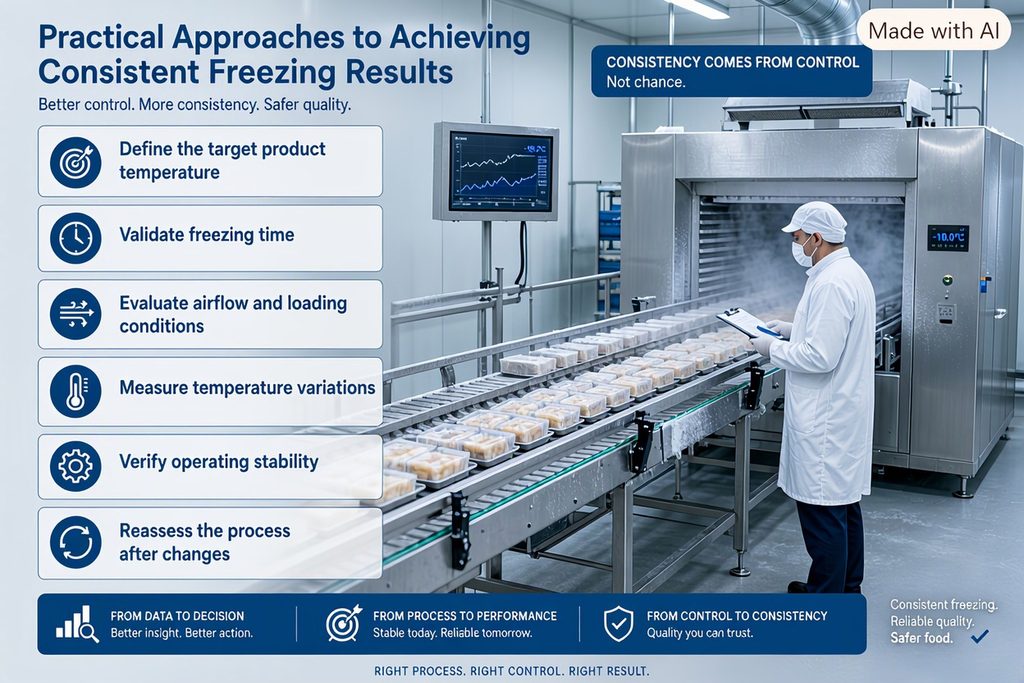
Temperature uniformity should be evaluated as part of an integrated production process rather than being judged solely by individual equipment settings.
A systematic control approach includes the following steps:
- Define the target product temperature: Determine the required thermal centre temperature and identify the applicable product standards and process requirements.
- Validate freezing time: Confirm that the time required for the product to pass through the Maximum Ice Crystallization Zone is within an appropriate range.
- Evaluate airflow and loading conditions: Check whether products are exposed to the cooling medium in a sufficiently uniform manner.
- Measure temperature variations: Collect temperature data from representative product samples and equipment locations under actual production conditions.
- Verify operating stability: Evaluate refrigeration system performance, evaporator frost accumulation, defrost cycles, and variations in production load.
- Reassess the process after changes: Repeat process validation whenever product specifications, loading rates, or equipment operating parameters are modified.
This approach helps distinguish whether performance issues are caused by insufficient refrigeration capacity, inadequate airflow distribution, excessive product loading, or inconsistent initial conditions of incoming raw materials.
Conclusion
The performance of an industrial freezing system cannot be evaluated solely by its operating air temperature.
−18°C is an important reference temperature for frozen food storage and cold chain management. It is also a key requirement for product thermal centre temperature under relevant quick-freezing standards.
Lower operating temperatures, such as approximately −35°C, are commonly used in industrial freezing equipment to accelerate heat removal during the freezing process.
However, achieving a low operating temperature does not necessarily guarantee uniform freezing throughout the product load.
Consistent freezing performance depends on the interaction of several factors, including refrigeration capacity, airflow distribution, product characteristics, loading conditions, and temperature monitoring.
For food processing facilities, the primary objective is to establish a stable and validated freezing process that consistently brings products to the required thermal state while avoiding unnecessary energy consumption and variations in product quality.
References and Further Reading
- Codex Alimentarius – Code of Practice for the Processing and Handling of Quick Frozen Foods (CXC 8-1976).
- ASHRAE Handbook – Industrial Food-Freezing Systems.
- European Commission – Quick-Frozen Food.
- FAO – Code of Practice for the Processing and Handling of Quick Frozen Foods.
- Codex Alimentarius – Standard for Quick Frozen Vegetables (CXS 320-2015).