
How to Choose Between Two Continuous Freezing Technologies?
In industrial food processing, spiral freezers and tunnel freezers are two commonly used types of continuous mechanical freezing equipment. Both typically rely on low-temperature forced-air circulation to remove heat from food through convective heat transfer between the cold air and product surfaces, bringing products down to the required freezing temperature.
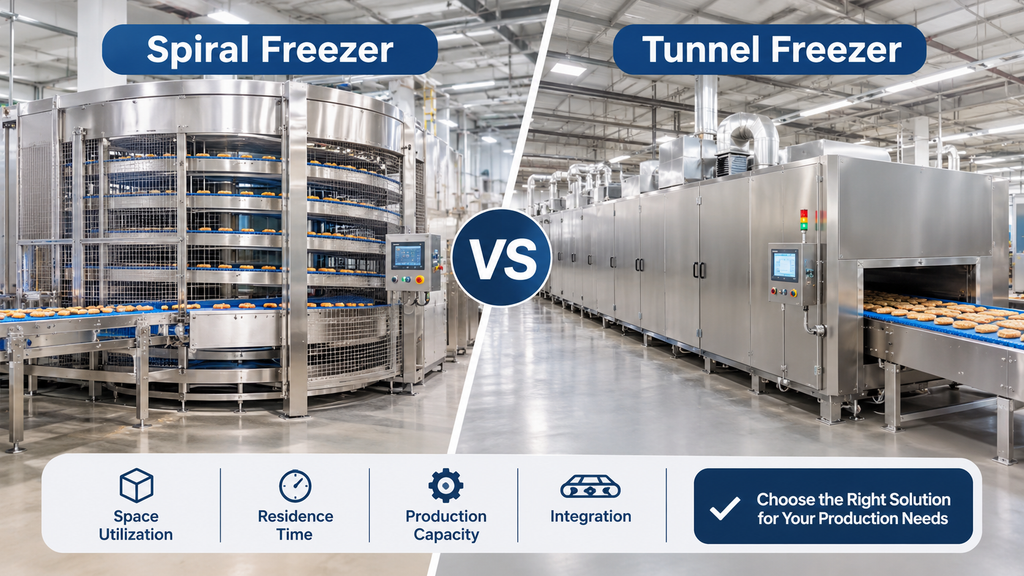
Although these two types of equipment share similar fundamental freezing principles, they differ significantly in conveyor configuration, space utilization, product residence time, and production line integration.
A spiral freezer uses multiple tiers of spiral conveyor belts to provide an extended freezing path within a relatively compact footprint. A tunnel freezer, by comparison, uses a horizontal, linear conveyor arrangement, with products moving through one or more freezing zones.
Neither technology is universally superior. Equipment selection should take into account available factory space, production capacity, product characteristics, required freezing time, and automation requirements.
1. Structural Design and Operating Principles
1.1 Spiral Freezer
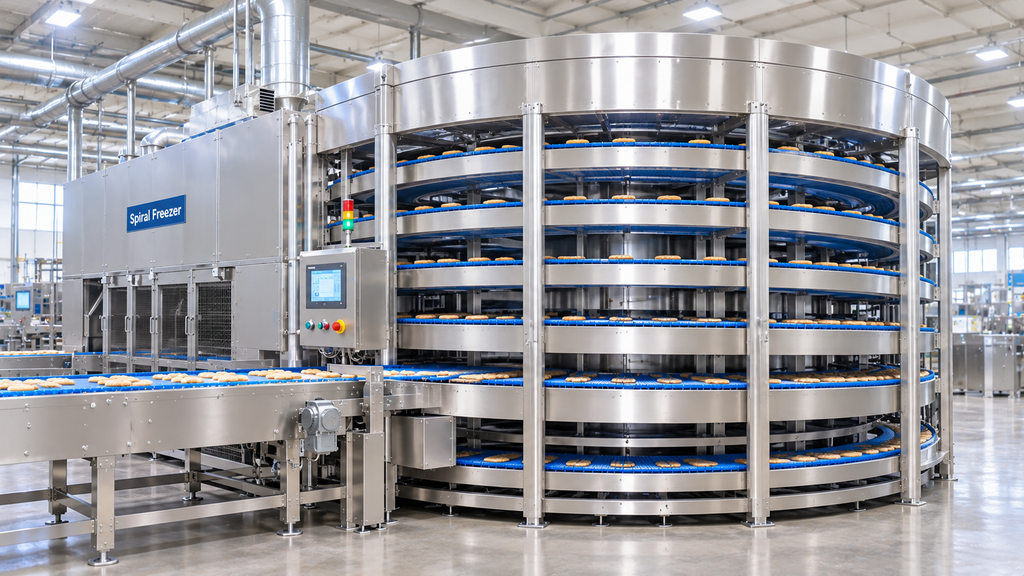
The core structure of a spiral freezer consists of a continuous conveyor belt that travels upward or downward around a central drum or supporting structure, forming multiple tiers of spiral conveying paths.
Products enter through the infeed, travel through the freezing enclosure along the spiral conveyor, and are discharged after completing the required freezing cycle.
The main components typically include:
- Multi-tier spiral conveyor belt
- Drive and belt tensioning systems
- Evaporators and circulation fans
- Insulated enclosure and airflow distribution structures
- Automatic control and cleaning systems
Based on the conveyor support arrangement, spiral freezers can generally be classified into two types: traditional drum spiral freezers and self-stacking spiral freezers.
Traditional designs typically rely on a central drum, rails, or other supporting mechanisms to guide and support conveyor movement. Self-stacking designs use the belt’s own stacking geometry to form multiple conveying tiers, reducing the need for certain conventional support structures.
Depending on the equipment design, airflow can be arranged horizontally, vertically, or through multiple controlled zones to accommodate different product freezing requirements.
Key characteristic: By utilizing vertical space to extend the effective conveyor path, spiral freezers can provide relatively long product residence times within a limited floor area.
1.2 Tunnel Freezer
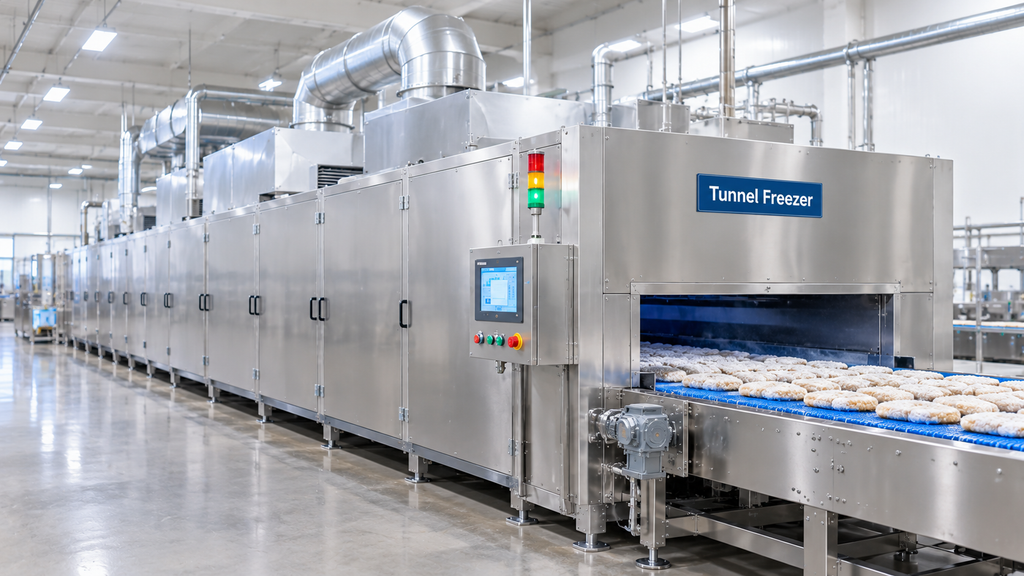
A tunnel freezer uses a horizontal, linear conveyor arrangement. Products travel through an insulated freezing enclosure on a mesh belt, solid belt, or other conveyor system while being exposed to continuously circulating low-temperature air.
The main components typically include:
- Horizontal conveyor belt and drive system
- Evaporators and circulation fans
- Air distribution and guiding structures
- Insulated tunnel enclosure and access sections
- Automatic control system
Based on airflow configuration and heat transfer design, tunnel freezers can be further classified into conventional forced-air tunnel freezers and impingement tunnel freezers.
Conventional tunnel freezers rely primarily on circulating cold air passing over product surfaces to remove heat. Impingement tunnel freezers use specially designed nozzles positioned above, below, or on one side of the product to direct high-velocity cold air jets onto the surface, intensifying convective heat transfer.
Tunnel freezers can also be configured with single-tier or multi-tier conveyor systems, with different tunnel lengths and conveying arrangements depending on product requirements and production line layouts.
Key characteristic: Their relatively straightforward structure and linear conveying path allow equipment length, conveyor speed, and airflow zones to be adjusted according to production requirements.
2. Footprint: Balancing Vertical and Horizontal Space
Floor space is one of the most noticeable differences between spiral and tunnel freezers.
A spiral freezer concentrates a relatively long conveying path within a vertical structure. This generally provides higher conveying capacity per unit of floor area. The design is particularly advantageous for factories with limited floor space but relatively long product freezing requirements.
A tunnel freezer uses a horizontal layout. As the required freezing time and conveyor length increase, more installation space is generally needed. However, its linear configuration can be extended along the production line and is often easier to adapt to existing factory layouts, including infeed, discharge, and equipment connection positions.
| Comparison Factor | Spiral Freezer | Tunnel Freezer |
|---|---|---|
| Primary space utilization | Vertical stacking | Horizontal extension |
| Equipment height | Generally higher | Generally lower |
| Floor space requirement | Relatively compact | Generally longer |
| Factory requirements | Sufficient ceiling clearance | Sufficient horizontal installation length |
| Layout flexibility | Limited by spiral tower configuration | Adjustable through conveyor length and direction |
It is important to distinguish the equipment footprint from the actual space requirements of the entire installation.
A spiral freezer also requires adequate overhead clearance, access for drive system maintenance, cleaning system provisions, and space for infeed and discharge conveyors. Tunnel freezers require sufficient space for conveyor connections at both ends, maintenance access, and evaporator servicing.
Therefore, space assessments should consider equipment dimensions, factory ceiling height, production line connections, and maintenance areas rather than comparing only the length and width of the equipment base.
3. Production Capacity and Efficiency: Freezing Time vs. Throughput per Unit of Space
Production efficiency is not determined solely by the type of freezer. It depends on several factors, including initial product temperature, target core temperature, product dimensions, required freezing time, conveyor width, loading density, and available refrigeration capacity.
3.1 Production Capacity Characteristics of Spiral Freezers
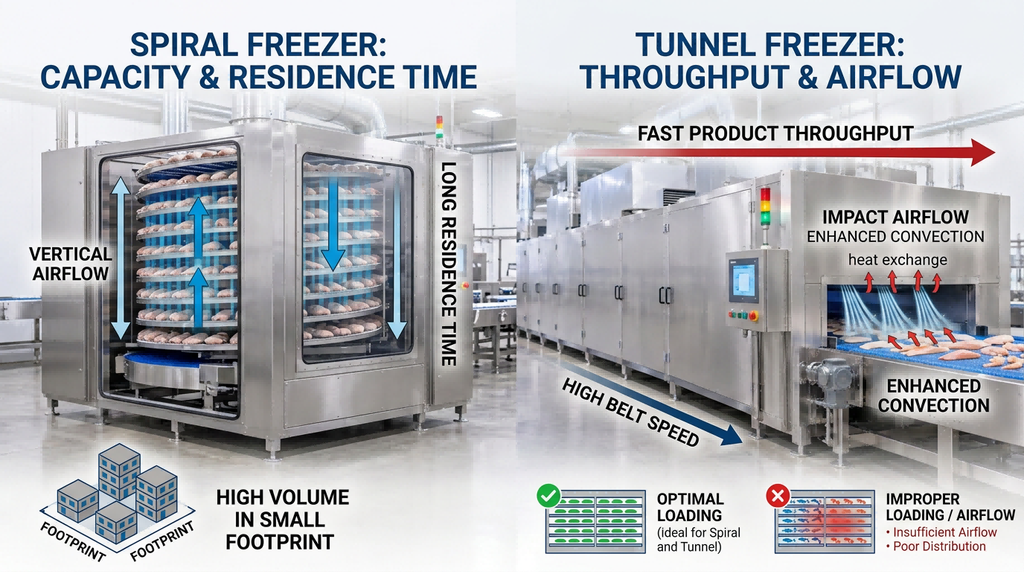
A spiral freezer can extend product residence time by increasing the number of conveyor tiers and the total conveyor length.
For products requiring relatively long freezing times, this configuration increases the amount of product that can be held inside the freezing enclosure without significantly increasing the equipment’s horizontal dimensions.
Actual processing capacity is primarily influenced by:
- Effective conveyor belt width
- Number of spiral tiers and total conveyor length
- Product loading density on the belt
- Conveyor speed and freezing time
- Airflow distribution and refrigeration system capacity
For meat, poultry, fish, and certain prepared foods, spiral freezers can provide relatively consistent residence times during continuous production.
However, increasing the number of conveyor tiers does not necessarily result in a proportional increase in throughput. Uneven airflow distribution, excessive product loading, or insufficient refrigeration capacity may create variations in freezing performance between different conveyor levels.
3.2 Production Capacity Characteristics of Tunnel Freezers
The processing capacity of a tunnel freezer is generally closely related to conveyor width, belt speed, freezing zone length, and product loading per unit of conveyor area.
For products requiring shorter freezing times, a linear tunnel configuration can achieve continuous processing through relatively high conveyor speeds.
This is particularly relevant to impingement tunnel freezers, where high-velocity air jets intensify convective heat transfer at the product surface. This makes them suitable for relatively thin foods with a large surface-area-to-volume ratio.
For example, hamburger patties, fish fillets, shrimp, and certain chicken products may benefit from intensified airflow to reduce freezing time.
However, a shorter freezing time does not automatically mean higher overall equipment throughput. Actual capacity remains limited by product thickness, initial temperature, target core temperature, and the production rates of upstream and downstream equipment.
3.3 Efficiency Comparison
| Comparison Factor | Spiral Freezer | Tunnel Freezer |
|---|---|---|
| Freezing path | Multi-tier continuous conveying | Horizontal continuous conveying |
| Product residence time | Suitable for extended residence times | Adjustable according to tunnel length |
| Conveying capacity per unit of floor area | Generally higher | Depends on equipment length and number of tiers |
| Intensified short-time freezing | Depends on airflow design | Impingement configurations offer advantages |
| Capacity expansion | Additional tiers, belt width, or equipment units | Increased length, width, or conveyor tiers |
From an engineering perspective, spiral freezers are generally worth evaluating first when products require extended freezing times and factory floor space is limited.
Tunnel freezers may be more suitable for relatively thin products requiring rapid surface heat transfer or production lines that need greater flexibility in adjusting freezing zone length.
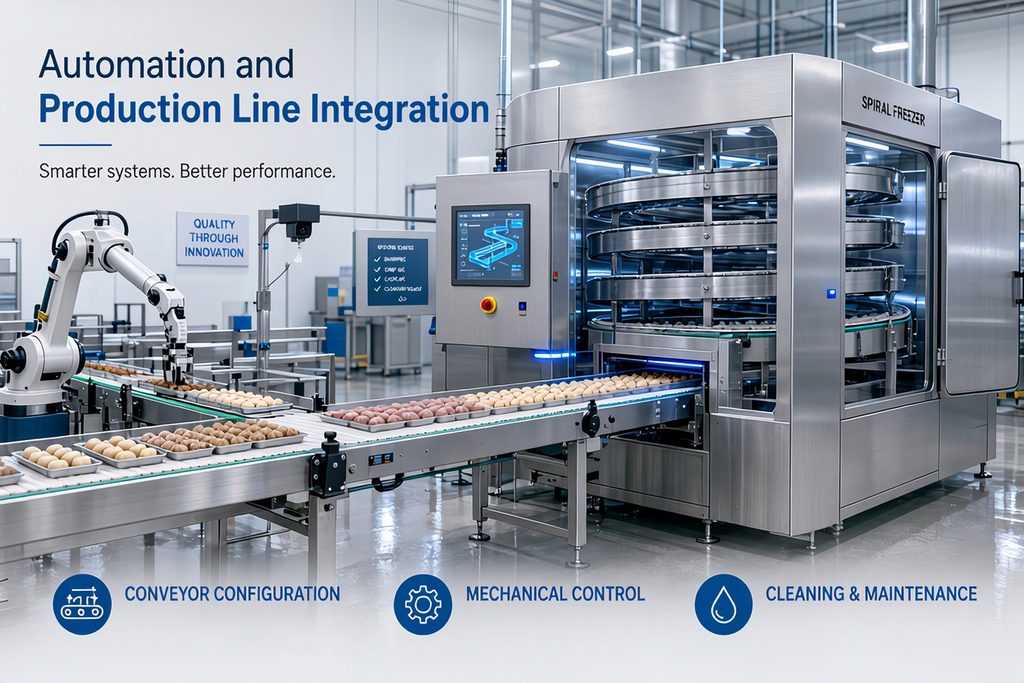
4. Automation and Production Line Integration
Both spiral and tunnel freezers can be integrated into automated food processing lines. The equipment type alone does not determine its level of automation. Differences are more closely related to conveyor configuration, mechanical control requirements, and cleaning and maintenance arrangements.
4.1 Spiral Freezers
Spiral freezers typically require coordinated control of the central drive system, conveyor belt tension, product infeed and discharge, and multi-tier conveying operation.
In automated production lines, they can be connected to upstream forming, frying, cooking, and cooling equipment, as well as downstream packaging systems.
Some advanced designs also incorporate Clean-in-Place (CIP) systems, Automatic Defrosting (ADF) systems, and equipment operating condition monitoring.
Because the conveyor path is relatively long and structurally complex, several design considerations become particularly important, including cleaning coverage, drainage, drive system reliability, and maintenance accessibility.
4.2 Tunnel Freezers
The horizontal conveyor arrangement of tunnel freezers generally makes them easier to connect to linear production lines.
Conveyor speed, fan frequency, freezing zone temperature, and product feed rates can be coordinated through a Programmable Logic Controller (PLC).
For factories that frequently change product specifications, tunnel freezer operating conditions can also be adjusted through conveyor speed, airflow parameters, and freezing zone configurations.
In impingement tunnel freezers, nozzle arrangement, upper and lower airflow balance, and conveyor operating conditions should also be incorporated into automatic control and process monitoring.
Overall, both technologies can achieve high levels of automation. Equipment selection should focus on production line synchronization, cleaning validation, fault recovery time, and maintenance requirements rather than simply whether a PLC is installed.
5. Suitable Food Applications: Product Characteristics Determine Equipment Selection
Different food products vary in size, thickness, moisture content, surface condition, and thermal properties. These characteristics directly affect freezing rates, product quality, and equipment suitability.
5.1 Typical Applications of Spiral Freezers
Spiral freezers are suitable for products requiring continuous conveying, relatively long freezing times, or freezing of larger individual portions.
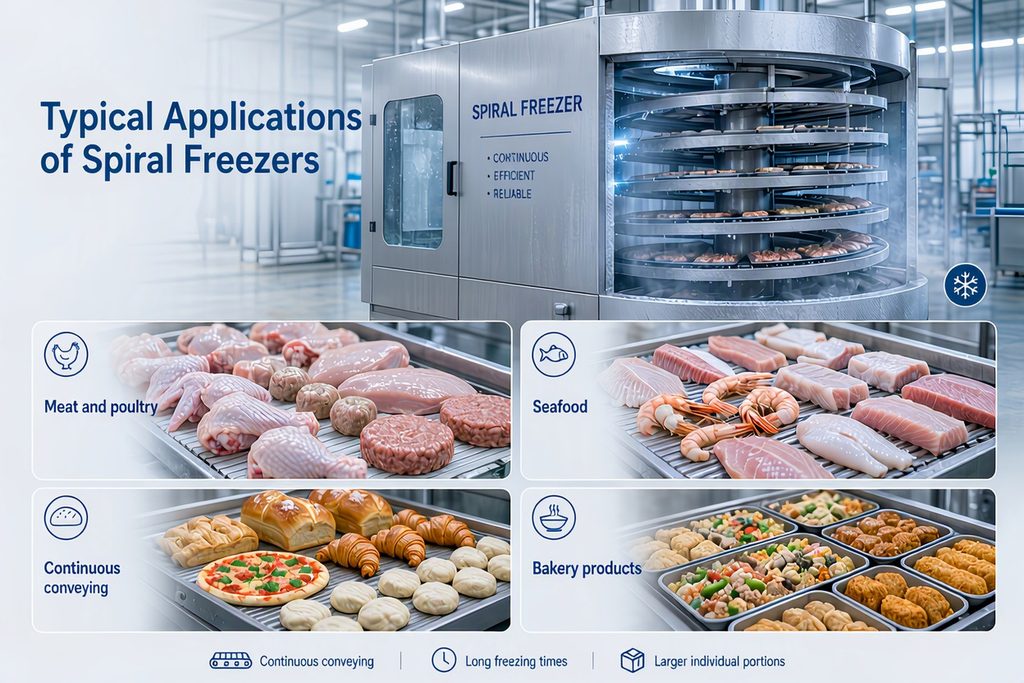
Typical applications include:
- Meat and poultry: Chicken pieces, chicken wings, chicken breasts, burger patties, meatballs, and cooked meat products.
- Seafood: Fish fillets, fish portions, shrimp, squid, and other seafood products.
- Bakery products: Bread, pizza, croissants, dough, and other bakery products or semi-finished items.
- Prepared foods: Ready meals, cooked foods, coated products, and convenience foods.
These products often have a certain thickness or volume and therefore require sufficient freezing time. Spiral conveying provides an extended freezing path within a relatively compact space while reducing the need for product transfers between separate conveying systems.
For products susceptible to deformation or surface damage, stable conveying can also help reduce mechanical impacts during processing.
5.2 Typical Applications of Tunnel Freezers
Tunnel freezers have a broad range of applications, particularly for products with clearly defined conveying directions and continuous processing requirements.
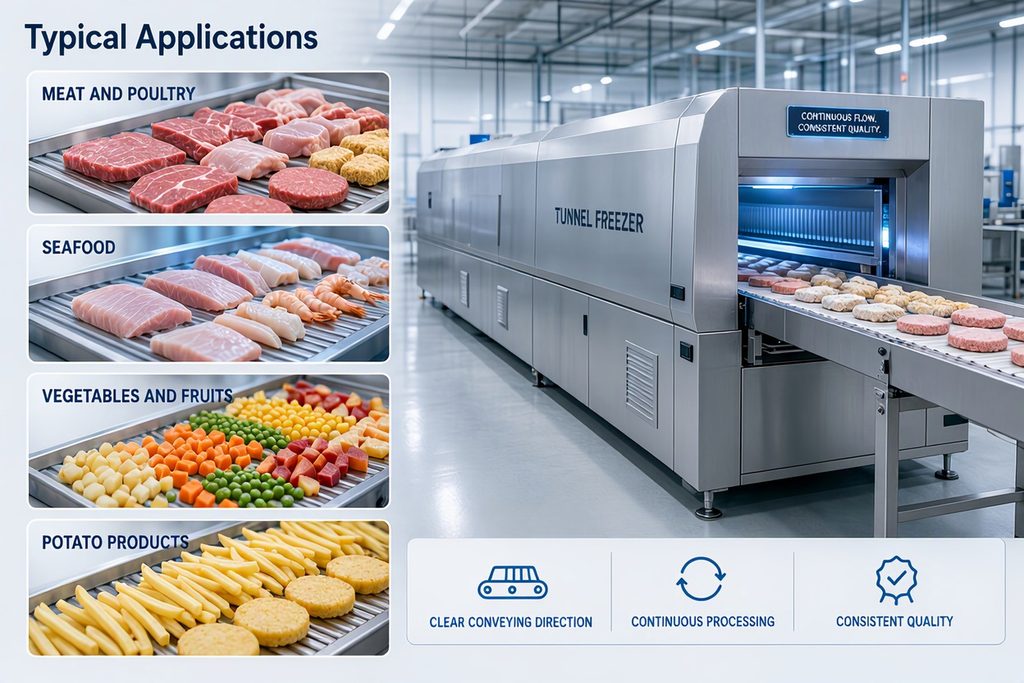
Typical applications include:
- Meat and poultry: Meat slices, chicken pieces, burger patties, and certain coated products.
- Seafood: Fish fillets, fish portions, shrimp, and selected seafood products.
- Vegetables and fruits: Selected diced vegetables, fruit slices, and other preprocessed products.
- Potato products: French fries, potato patties, and other products with relatively uniform dimensions.
Conventional mesh-belt tunnel freezers are suitable for standard forced-air freezing, while impingement tunnel freezers are particularly useful for relatively thin products requiring intensified surface heat transfer.
For example, potato patties, hamburger patties, fish fillets, and chicken portions can benefit from high-velocity airflow directed from above and below the products.
It is also important to distinguish conventional tunnel freezers from fluidized-bed IQF freezers. For small individual products such as peas, corn kernels, blueberries, and diced vegetables, where individual separation and prevention of product agglomeration are required, fluidized-bed freezing technology may need to be evaluated separately.
6. Equipment Selection: Which Factors Should Be Prioritized?
In practical projects, the selection between spiral and tunnel freezers should be based on processing requirements and factory conditions rather than simply comparing equipment prices or nominal capacities.
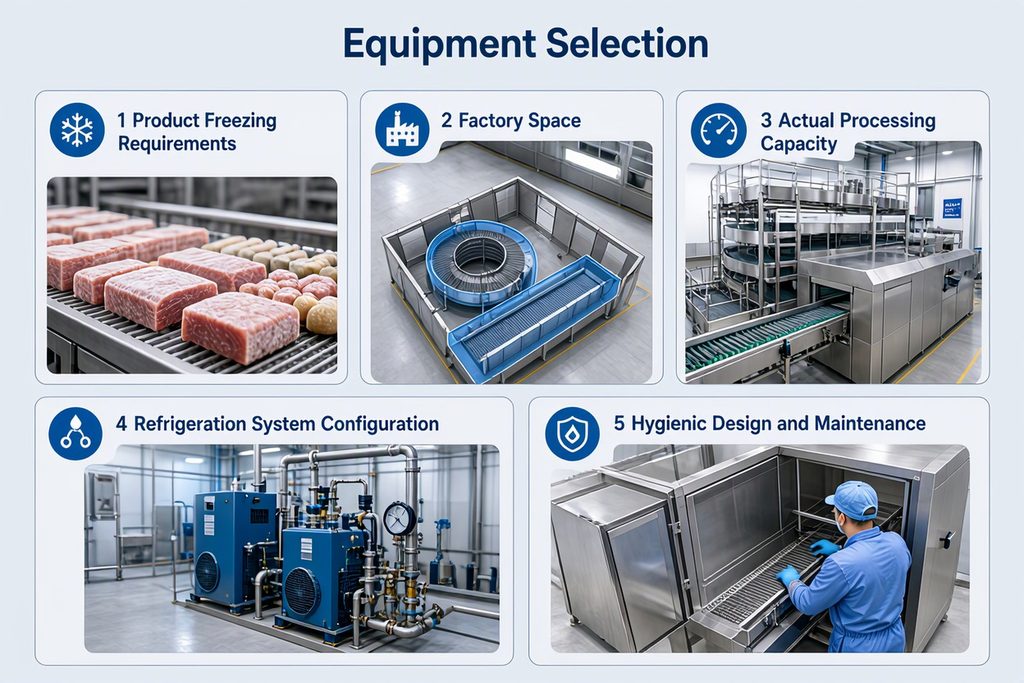
The following factors deserve particular attention:
1. Product Freezing Requirements
Determine product dimensions, thickness, initial temperature, target core temperature, and required freezing time. Thicker products generally require longer freezing times, while high-intensity airflow freezing technologies may be considered for relatively thin products.
2. Factory Space
If horizontal installation space is limited but sufficient ceiling clearance is available, a spiral configuration may be worth prioritizing. Where sufficient linear installation space exists, a tunnel freezer may integrate more easily with the existing production line.
3. Actual Processing Capacity
Equipment should not be selected based solely on its rated throughput. Manufacturers should calculate processing capacity based on the actual product and confirm the relevant testing conditions, including product temperature, target core temperature, loading density, and conveyor speed.
4. Refrigeration System Configuration
The equipment must be compatible with the factory’s existing refrigeration system, including refrigerant type, evaporating temperature, refrigeration capacity, piping connections, and defrosting method.
For replacement projects, the feasibility of retaining existing compressors and other refrigeration infrastructure should also be evaluated.
5. Hygienic Design and Maintenance
Important considerations include conveyor cleaning coverage, drainage arrangements, evaporator defrosting, internal maintenance access, and accessibility of critical mechanical components.
7. Conclusion: Neither Spiral nor Tunnel Freezers Are Universally Superior
Spiral and tunnel freezers are both established technologies for continuous food freezing, but they are designed to address different production conditions.
The primary advantages of spiral freezers lie in their vertical space utilization and extended product conveying paths. They are suitable for food processing environments requiring relatively long freezing times, continuous high-volume production, and efficient use of limited floor space.
Tunnel freezers offer linear conveying and flexible structural configurations. They are particularly suitable for production lines where freezing zone length, conveyor speed, and airflow distribution can be adjusted to meet different processing requirements. Impingement tunnels also provide intensified surface heat transfer for relatively thin products.
Ultimately, appropriate equipment selection should be based on product freezing requirements while taking into account factory layout, production schedules, automation levels, hygienic design, and overall refrigeration system operating conditions.
For food factories planning to upgrade existing production lines, equipment dimensions, inlet and outlet elevations, conveyor direction, and refrigeration connections should also be evaluated to avoid compatibility issues with the existing production system.
In some replacement projects, manufacturers can develop customized equipment designs based on the original equipment brand, model, technical specifications, and on-site measurements rather than relying solely on standard replacement models.
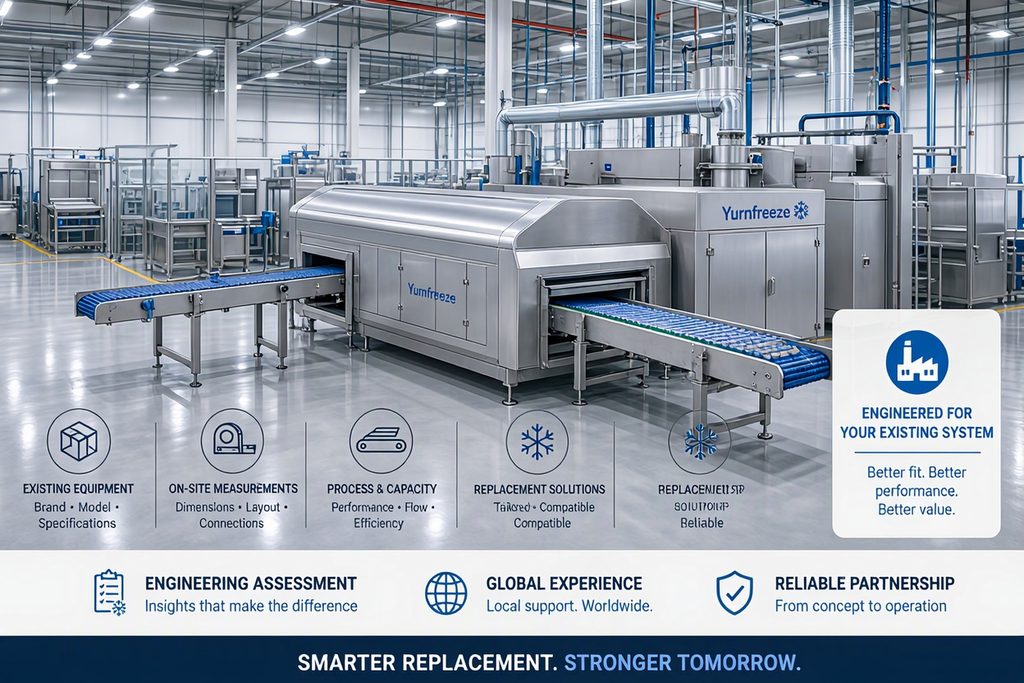
For example, Yurnfreeze provides customized equipment engineering and replacement services for industrial spiral and tunnel freezers. Its engineering assessments can take into account existing equipment dimensions, conveyor configurations, processing capacity, inlet and outlet layouts, and refrigeration system connections. These assessments can support the development of replacement solutions for existing spiral freezers, tunnel freezers, and equipment from other manufacturers.
FAQ
1. Is a spiral freezer more space-efficient than a tunnel freezer?
Generally, yes, in terms of floor space. A spiral freezer uses vertically stacked conveyor levels to provide a long freezing path within a relatively compact footprint. A conventional single-tier tunnel freezer requires more horizontal installation space.
However, spiral freezers require greater ceiling clearance and sufficient space for maintenance access.
2. Which freezer is better for high-capacity food production?
Neither technology is universally superior. Spiral freezers are suitable for high-volume continuous production where extended residence time and compact floor space are important.
Tunnel freezers can achieve high throughput through wider conveyor belts, higher belt speeds, or multi-tier conveyor configurations. Actual processing capacity depends on product characteristics and freezing requirements.
3. Can a tunnel freezer freeze products faster than a spiral freezer?
In certain applications, yes. An impingement tunnel freezer uses high-velocity air jets to enhance surface heat transfer, making it suitable for relatively thin products such as hamburger patties, fish fillets, and chicken portions.
However, freezing time also depends on product thickness, initial temperature, and target core temperature.
4. Can spiral and tunnel freezers process the same types of food?
There is considerable overlap in their applications. Both technologies can process meat, poultry, seafood, bakery products, and prepared foods.
The more important considerations are product dimensions, surface characteristics, required freezing time, loading density, and handling requirements.
5. What should be checked when replacing an existing spiral or tunnel freezer?
Key considerations include the original equipment dimensions, conveyor width and height, inlet and outlet positions, required processing capacity, freezing time, refrigeration system connections, electrical specifications, and available maintenance space.
Before installation, the compatibility of the replacement equipment with the existing refrigeration infrastructure should also be evaluated. This includes checking refrigerant type, evaporating temperature, available refrigeration capacity, and piping connections.
In some cases, customized replacement equipment may be designed to match the existing production line layout and utility connections, reducing the need for extensive modifications to the surrounding facility.