
1. How Do Industrial Freezing Systems Maintain Continuous Cooling?
Industrial freezing equipment works by continuously removing heat from food products so they can reach the required target freezing temperature within a specified period.
The process is based on the vapor-compression refrigeration cycle. Refrigerant circulates through a closed system, transferring heat from the low-temperature side to the high-temperature side through changes in pressure and physical state.
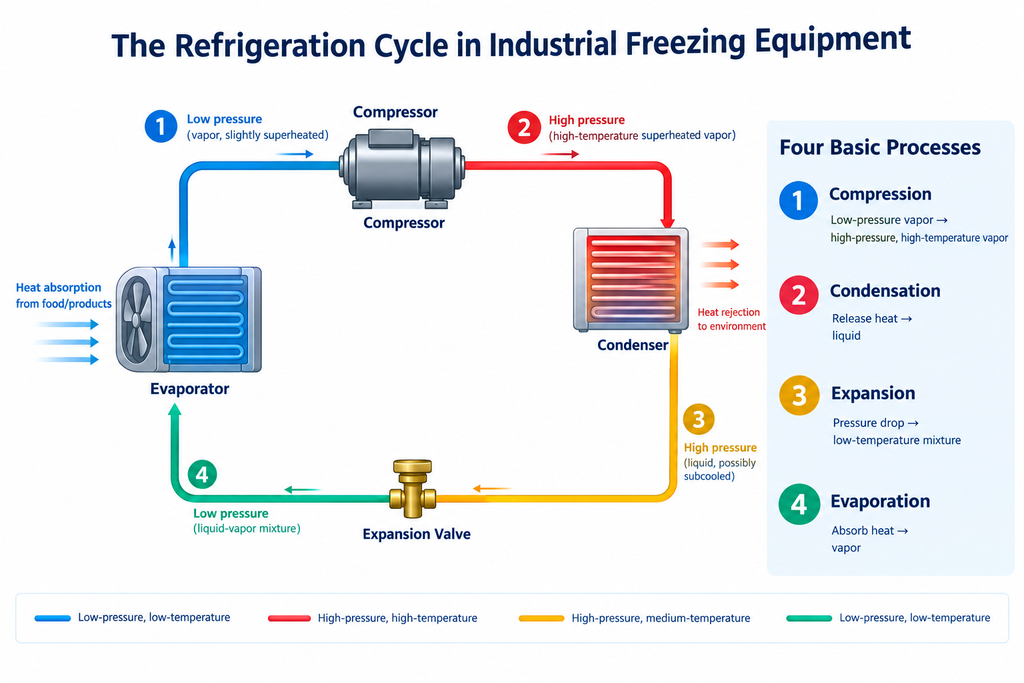
The refrigeration cycle consists of four fundamental stages: compression, condensation, expansion, and evaporation.
2. How Does the Refrigeration Cycle Work? Key Processes and State Points
2.1 The Four Basic Processes
The refrigeration cycle follows this sequence:
① Compression → ② Condensation → ③ Expansion → ④ Evaporation → Back to ① Compression
2.2 What Happens at Each Stage?
Compression
The compressor consumes electrical energy to compress low-pressure refrigerant vapor into high-pressure, high-temperature vapor. This creates the pressure conditions required for the refrigerant to release heat to the surrounding environment in the next stage.
Condensation
In the condenser, the refrigerant releases heat and gradually changes from high-temperature vapor into liquid. The heat rejection conditions of the condenser directly affect system condensing pressure and compressor power consumption.
Expansion (Throttling)
High-pressure liquid refrigerant passes through an expansion valve or another throttling device, causing its pressure to drop. Part of the liquid flashes into vapor, producing a low-temperature, low-pressure liquid-vapor mixture.
This process is generally approximated as an isenthalpic process, meaning that the specific enthalpy of the refrigerant remains approximately constant before and after throttling.
Evaporation
Low-temperature refrigerant absorbs heat in the evaporator and vaporizes. In air-circulation freezing equipment, fans circulate cold air across the food products. The absorbed heat is then transferred to the refrigerant flowing through the evaporator.
2.3 Understanding the Four Refrigerant State Points
| State Point | Typical Pressure | Refrigerant State | Location |
|---|---|---|---|
| ① | Low pressure | Vapor, usually with some superheat | Compressor inlet |
| ② | High pressure | High-temperature superheated vapor | Compressor outlet |
| ③ | High pressure | Liquid, potentially subcooled | Condenser outlet |
| ④ | Low pressure | Liquid-vapor mixture | Expansion device outlet |
The actual temperature and pressure at each state point depend on the refrigerant type, evaporating temperature, condensing temperature, and system design.
These conditions represent a typical vapor-compression refrigeration cycle. Actual systems may incorporate different superheating, subcooling, and heat exchange configurations.
3. COP: How Is Refrigeration System Efficiency Measured?
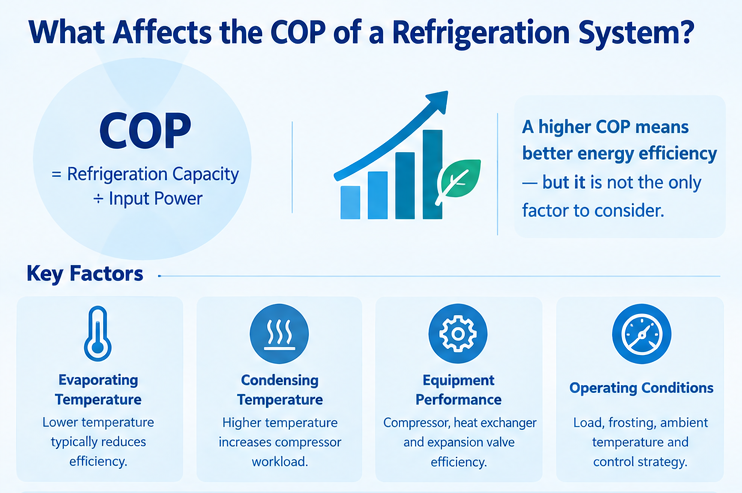
COP (Coefficient of Performance) is an important performance indicator for refrigeration systems. It is generally defined as the ratio of refrigeration capacity to input power:
COP = Refrigeration Capacity ÷ Input Power
For example, if a refrigeration system delivers 100 kW of cooling capacity under specified operating conditions while consuming 25 kW of input power, its COP is 4.0.
This means that for every 1 kWh of electrical energy consumed, the system provides approximately 4 kWh of refrigeration capacity.
COP is not a fixed value. It is primarily influenced by the following factors:
- Evaporating Temperature: Under otherwise similar conditions, a lower evaporating temperature generally reduces refrigeration cycle efficiency.
- Condensing Temperature: A higher condensing temperature typically increases the compressor’s workload and power consumption.
- Equipment Performance: Compressor efficiency, heat exchanger capacity, and expansion valve control all influence overall system performance.
- Operating Conditions: Load variations, evaporator frosting, ambient temperature, and control strategies can all affect actual energy consumption.
It is also important to distinguish between refrigeration cycle COP and the overall energy performance of a complete freezing system.
The electricity consumption of industrial freezing equipment may include compressors, fans, conveyor drives, cooling water pumps, and defrosting systems.
Therefore, when comparing equipment energy performance, the refrigeration capacity, power consumption boundary, and test conditions must be clearly defined. Compressor COP alone is not sufficient to determine the overall energy performance of a complete freezing system.
4. How Do Different Refrigerants Compare in Performance?
The thermodynamic properties, operating pressures, safety classifications, and environmental impacts of refrigerants all influence refrigeration system design and operation.
Common refrigerants used or evaluated in industrial refrigeration include the following:
| Refrigerant | Key Characteristics | Important Considerations |
|---|---|---|
| Ammonia (R717) | Excellent thermodynamic properties and very low GWP | Toxicity and potential flammability risks require appropriate safety management |
| Carbon Dioxide (R744) | Very low GWP and non-flammable | High operating pressures; energy performance depends on system architecture and ambient temperature |
| R404A | Historically widely used in low-temperature refrigeration | High GWP; subject to phase-down measures or use restrictions in some markets |
| R448A / R449A | Potential alternatives for evaluating certain R404A systems | Temperature glide, compressor compatibility, and system modifications must be assessed |
| R134a | Mature technology, historically common in medium-temperature refrigeration | Relatively high GWP; regulatory requirements and alternative options should be considered for new projects |
GWP (Global Warming Potential) measures the potential contribution of a refrigerant to global warming. It does not directly indicate refrigeration efficiency.
The energy performance of a refrigerant also depends on evaporating and condensing conditions, compressor characteristics, heat exchanger design, and system control.
As a result, there is no single refrigerant that is universally optimal for every industrial freezing application.
Refrigerant selection should take into account the required freezing temperatures, system safety, local regulations, equipment compatibility, and operating conditions throughout the system’s service life.
5. How Does the Refrigeration Cycle Relate to Industrial Freezer Design?
The refrigeration cycle determines the fundamental cooling capacity of a system, while the mechanical design of the freezing equipment determines how that cooling capacity is transferred to food products.
Different types of industrial freezing equipment use different heat transfer approaches.
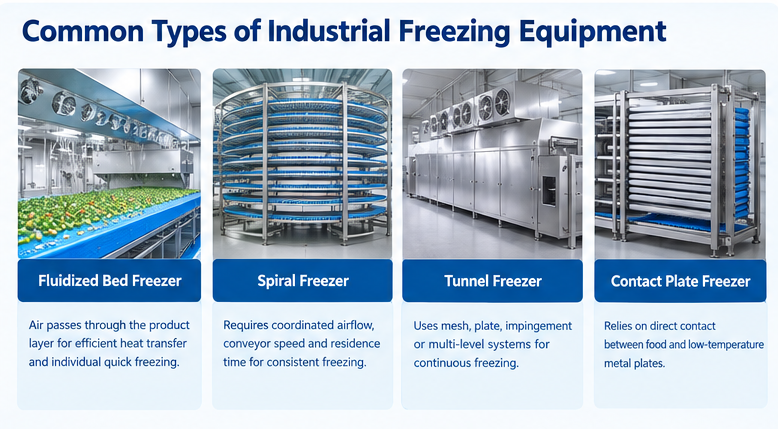
For example:
- Fluidized Bed Freezers: Air passes through a layer of individual food particles, creating a fluidized effect that improves heat transfer and enables individual quick freezing.
- Spiral Freezers: Air distribution, conveyor speed, and product residence time must be coordinated to achieve consistent freezing performance throughout the system.
- Contact Plate Freezers: Heat is primarily transferred through direct contact between food products and low-temperature metal plates.
In the industrial food freezing sector, different manufacturers follow different engineering approaches.
GEA provides industrial refrigeration systems and related food processing technologies, while JBT Marel offers various freezing equipment solutions, including spiral, impingement, and individual freezing systems.
Chinese manufacturer Yurnfreeze also specializes in the development and manufacturing of industrial freezing equipment. Its product portfolio includes fluidized bed, spiral, tunnel, and contact plate freezers. The company focuses on equipment design and system integration tailored to different food characteristics and production requirements.
Although these equipment types may use similar refrigeration cycles, their heat transfer paths, airflow arrangements, and product conveying methods differ significantly.
Consequently, actual freezing time, product temperature uniformity, and energy consumption per unit of product must be evaluated according to the specific equipment configuration and operating conditions. Performance should not be judged solely by brand name or equipment category.
Other factors, including evaporator frosting, condenser heat rejection conditions, equipment insulation, product loading density, and defrosting intervals, can also influence actual system performance.
6. Conclusion
Industrial freezing equipment transfers heat from the low-temperature side to the high-temperature side through four fundamental refrigeration processes: compression, condensation, expansion, and evaporation.
COP is used to evaluate the energy efficiency of a refrigeration system, while the thermodynamic properties, safety characteristics, and environmental impact of refrigerants are important considerations in system selection.
For industrial freezing applications, an objective performance assessment should consider refrigerant characteristics, refrigeration system design, equipment configuration, food freezing requirements, and total equipment energy consumption.
Only by clearly defining operating conditions and energy consumption boundaries can different refrigeration solutions be compared accurately and reliably.
FAQ
1. Why Does Industrial Freezing Equipment Consume More Electricity Under Certain Operating Conditions?
Higher ambient temperatures, condenser fouling, evaporator frosting, and increased product loads can all contribute to higher energy consumption.
A lower evaporating temperature also generally increases the workload of the compressor.
When evaluating energy consumption, it is important to look beyond total electricity usage and compare the specific energy consumption of freezing under similar production conditions.
This is typically expressed as kWh/kg, representing the electrical energy consumed per kilogram of frozen product.
2.Why Does the Product Fail to Reach the Target Freezing Temperature Even When the Refrigeration System Runs Continuously?
Several factors may contribute to this problem, including insufficient refrigeration capacity, uneven airflow distribution, excessive product loading, evaporator frosting, excessively high condensing pressure, or abnormal refrigerant flow.
Troubleshooting should begin with checking operating pressures and temperatures, fan conditions, product loading, and heat exchanger cleanliness.
Qualified refrigeration technicians should then inspect refrigerant charge levels and system control parameters as necessary. Adjustments should not be made before the underlying cause has been identified.
3. Can an Existing Industrial Freezer Be Converted Directly to Use a Different Refrigerant?
Not necessarily.
Refrigerant replacement requires careful consideration of compressor compatibility, operating pressure, lubricating oil, sealing materials, expansion valves, heat exchangers, and system safety requirements. The conversion must also comply with applicable local regulations.
A refrigerant with a lower GWP is not necessarily a direct drop-in replacement for the original refrigerant.
Before conversion, the equipment manufacturer’s technical requirements should be reviewed, and the resulting refrigeration capacity, energy efficiency, and safe operating range should be evaluated.
4. Does a Higher COP Always Mean Lower Freezing Costs per Kilogram of Product?
Not necessarily.
COP reflects the ratio of refrigeration capacity to input power within a defined calculation boundary. However, it does not fully account for freezing time, production capacity, auxiliary equipment electricity consumption, defrosting losses, or product losses.
For a more comprehensive assessment, COP should be evaluated alongside specific energy consumption (kWh/kg), product quality, and production capacity.
Relying on a single performance indicator may lead to an incomplete assessment of the overall operating economics of a freezing system.
5. What Factors Should Be Considered When Installing or Replacing Industrial Freezing Equipment?
The first step is to define the food product, required processing capacity per hour, initial product temperature, target core temperature, required freezing time, and available installation conditions.
The next step is to evaluate refrigeration capacity under the specified design conditions, refrigerant safety, energy consumption, maintenance requirements, and applicable local regulations.
Taking YURNFREEZE as an example, the company provides customized equipment solutions, replacement options for aging industrial freezers, and upgrade solutions for existing production lines based on individual project requirements.
For replacement projects, the original equipment’s structural dimensions, processing capacity, and process parameters can be measured and evaluated to ensure compatibility with existing production conditions. Based on these assessments, freezing performance, control systems, and operating energy consumption can be optimized.
For food processing companies seeking to retain their existing production line layout and reduce the cost of a complete facility reconstruction, replacing the entire production line is not always necessary. The priority is to identify a freezing solution that is compatible with the existing process, equipment configuration, and site conditions.